
ELLMENT for the CH-47 Chinook
Ask at the aircraft. Get the manual's own paragraph.
On a laptop or tablet, with no network. When no manual has the answer, it says so.
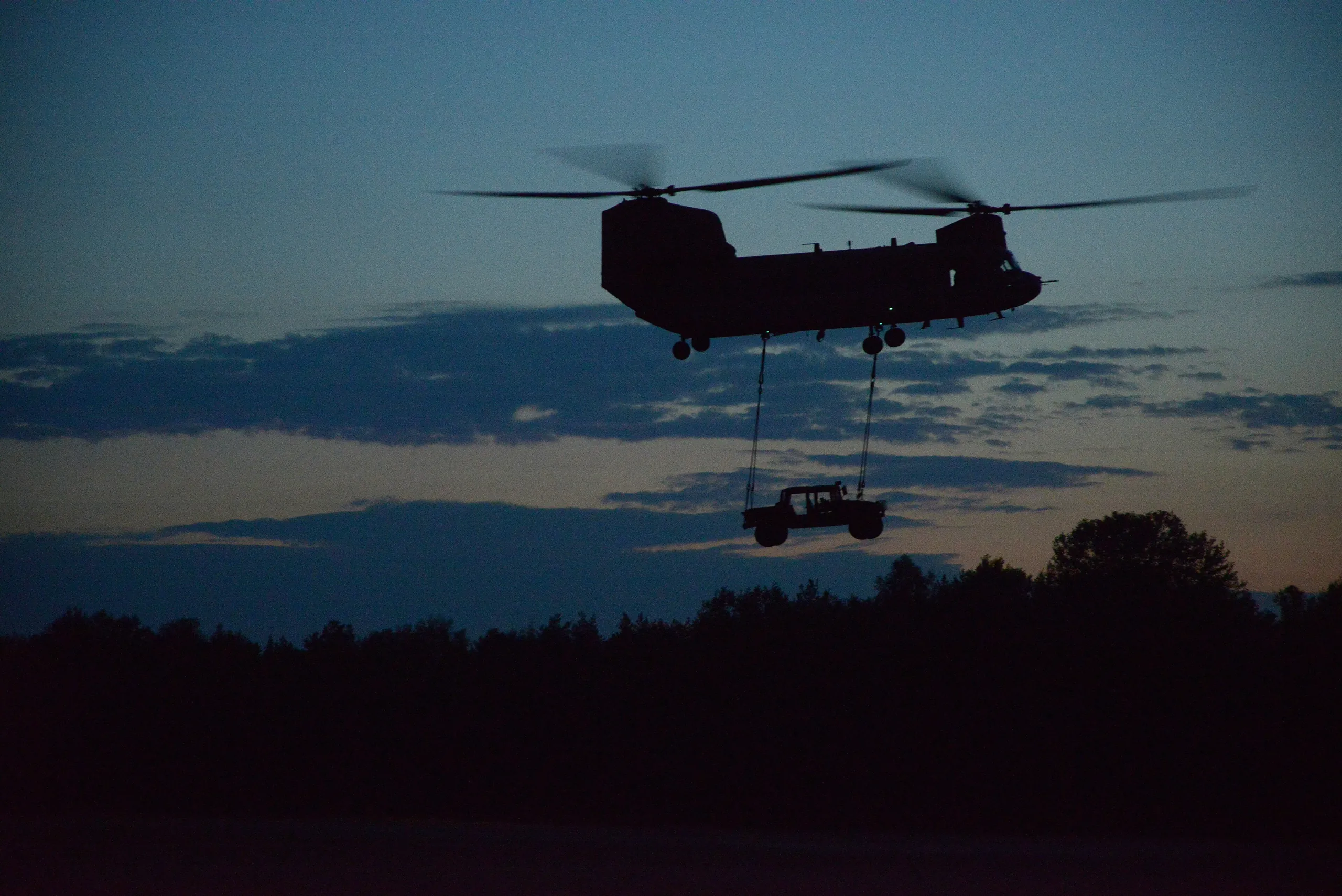
CH-47F sling-load training at dusk · U.S. Army photo by Christoph Koppers, public domain
ELLMENT puts the Chinook's manuals on a laptop or tablet that answers questions with no network. A CH-47 repairer or flight engineer types a question at the aircraft, and ELLMENT shows the exact paragraph from the CH-47 manual, the sling-load manual or the unit's SOP, word for word, with the manual number and page.
This page describes a concept white paper Azcuna Dynamics submitted to the Army's xTech|Search 10 competition in October 2026. ELLMENT is the same engine Azcuna proposed to the Navy for E-2D aircrews. Everything shown is Azcuna's own privately funded work.
Asked at the aircraft
Three places on the aircraft, three kinds of question.
The answer screen
A load no rigging manual covers.
Classification definitions of sling load
Unique Sling Loads. Unique loads are equipment carried on a one time or low-frequency basis, such as telephone poles, artillery targets, or barrier material. The lack of sling load certification in itself does not preclude a commander from carrying a unique load. Due to the lack of rigging procedures, unique loads shall be considered high risk loads. Only the most experienced personnel should attempt to rig and inspect a unique load. [...] The movement of unique loads shall be approved by the high risk approving authority (Operational Risk Management (ORM) high risk authority for Navy/USMC).
Illustration of the prototype's answer screen. The paragraph is the public-release text of TM 4-48.11 (5 July 2013), Chapter 1, para 1-2, word for word; [...] marks a cut.
Piers, ship decks and island strips.
The crew has its manuals there, offline, and searches them by hand, one file at a time. The Army tools that answer questions need a network.
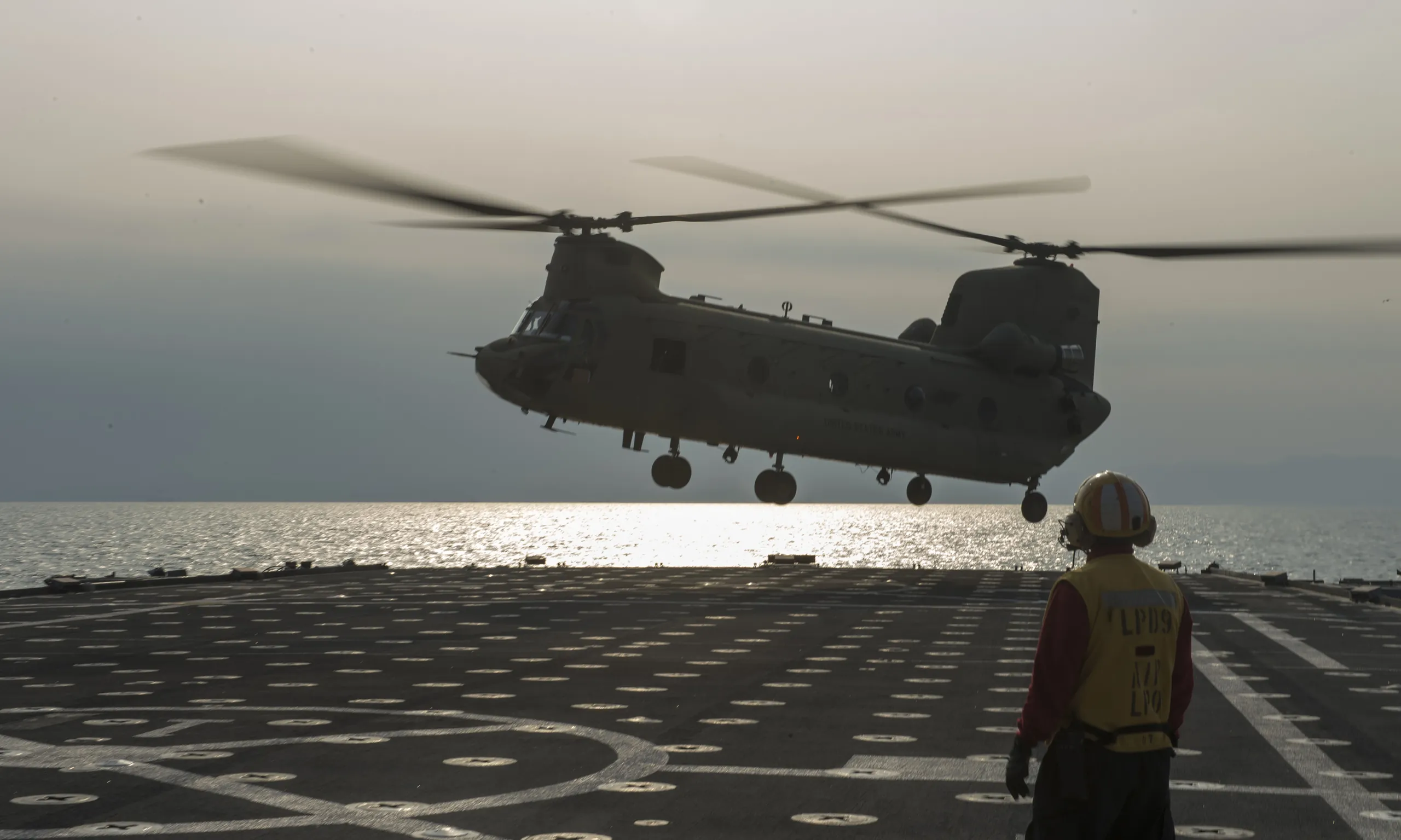
Army CH-47F on the flight deck of USS Denver (LPD 9) · U.S. Navy photo, public domain
The Army's own record
A Class A mishap. A slung relocatable building struck a deployed CH-47F at about 1,000 feet.
“should have been categorized as unique loads requiring high risk approval authority”
The review also warned against practices “disseminated through word of mouth.” The rule was already in print: the paragraph on the screen above.
“a 45 percent loss in CH-47 combat power within the division”
The cost of unfilled 15U flying positions. With fewer 15Us, the Soldier who repairs the aircraft also flies on it, so time spent finding a step comes out of repair time.
“master libraries are outdated”
A crew working from an old copy of a manual cannot see that the paragraph in front of it has changed.
Same rule, two verbs
should/shall
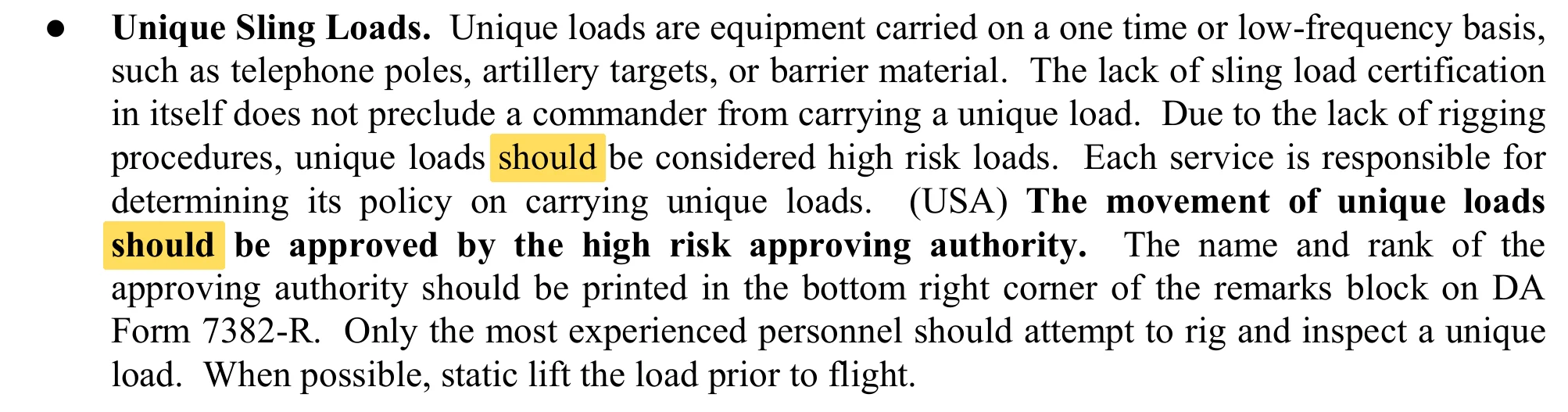
Two Army sling-load manuals, a year apart, state the unique-load rule in the same words, except the verb. A model that summarizes has to pick one. ELLMENT shows the page, so the difference stays in view.
Tap a page to open it full size

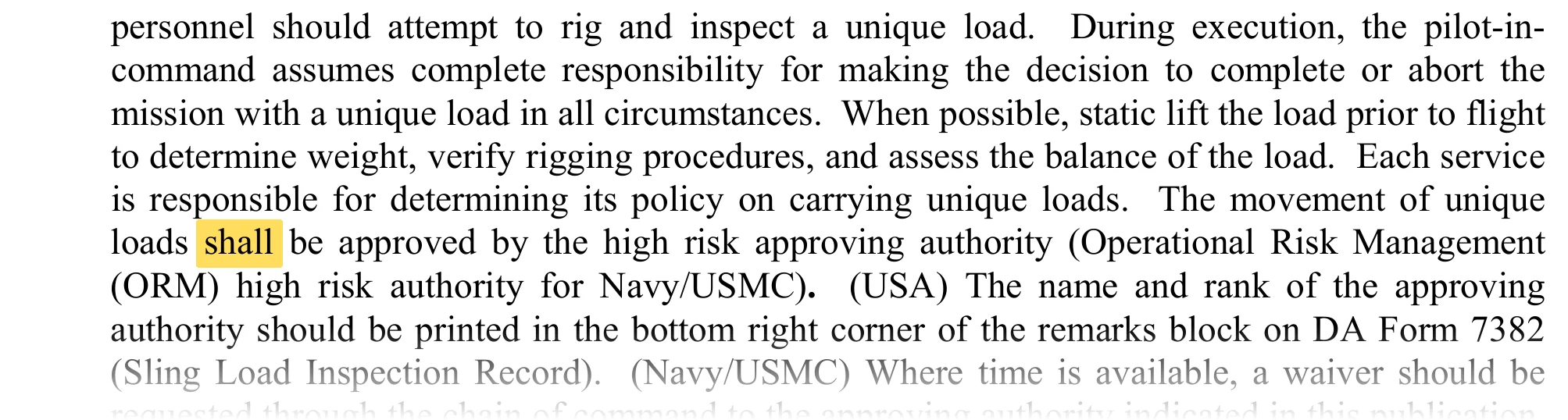
Tap a page to open it full size
Crops of the public-release Army Publishing Directorate PDFs, as printed; the marks are ours. Showing conflicting wording side by side, with each manual's date, is Phase I work.
How it decides
Three checks run before any model does.
The answer of record is never model-written text. Three fixed checks, with no language model in them, decide between an answer and a decline.
The reference exists
Every paragraph, figure, table, chapter or appendix number in the question is checked against an outline of the loaded publications.
Example
The answer is in print
The kind of answer asked for, a limit, a step, an approval, must be printed near the subject of the question.
Example
Documents cannot give orders
Sentences in a loaded document that address the software as instructions are withheld before any model sees them.
Example
What passes is shown word for word, with the manual number and page. An on-device language model (2 to 5 GB, U.S.-origin open weights) can add a one-line summary beneath the paragraph; a no-model mode runs without it.
Measured on the prototype
Every dot is one test.
Dots are the same size in every tile; green means the result came out right. Azcuna's own measurements on the working prototype: five Navy aviation publications, 1,933 pages, a 16 GB laptop, every reference answer checked against the source page. The CH-47 manuals are loaded in Phase I.
The 870 answerable questions are 290 questions in three phrasings each; on a separate untouched set, the same checks blocked 0 of 117. Finding the page: in 297 blind-written runs (99 questions, three phrasings each), the reference page was retrieved in 192 of 237 answerable runs (81 percent), and the cited page was correct, within one page, on 131 of 168 answers. On blind-written questions the manuals do not answer, 32 of 36 runs declined (89 percent). The network checks ran with the operating system denying all network access; no outbound connection was attempted.
The approved paragraph, never a restatement
Airworthiness approval covers “all electronic rendition” of technical-manual data “in flight, planning and maintenance devices.” ELLMENT shows the approved paragraph. It never restates a limit or computes a value.
No superseded publications
Para 5-7: outdated required publications “will not be stored on the EFB for any reason.” ELLMENT blocks a superseded publication, and Phase I locks every answer to the current change of each manual.
Phase I · six months
From the CH-47 manuals to Soldiers at Chinook units.
- Months 1-2Army manual ingest, every answer locked to the current change
- Months 2-4Unit SOPs, bulletins and rigging cards; conflicts side by side; load lookup
- Months 4-6Soldiers at Chinook units test it against the viewer they use now
Exit criteria
- Zero answers from a superseded change of a manual
- Correct declines on at least 95 percent of questions the loaded publications do not answer
- The correct paragraph on screen at least five times faster than the current method
- A written ground-use determination requested from Army airworthiness
Key assumptionsCustody, first use, manual format+
- The unit loads its own manuals onto a device it already operates, so Azcuna never holds restricted manuals
- First use is on the ground, at the hangar, ramp or pier; in-flight use waits for an airworthiness determination
- Army electronic manuals break into numbered paragraphs as cleanly as the publications tested so far; Phase I tests this first
Program facts
- Platform
- CH-47 Chinook
- Users
- CH-47 repairers (15U) and flight engineers
- Vehicle
- Army xTech|Search 10 concept white paper
- Status
- Concept submitted October 2026
- Stage
- Working prototype (TRL 4)
- Device
- A laptop or tablet the unit already operates
- Runtime
- No network, no login
- Manuals
- Loaded by the unit; Azcuna never holds restricted publications
- First use
- On the ground: hangar, ramp, pier
- Engine
- ELLMENT, also proposed to the Navy for E-2D aircrews
Program FAQ
ELLMENT puts the Chinook's manuals on a laptop or tablet that answers questions with no network. A CH-47 repairer or flight engineer types a question at the aircraft, and ELLMENT shows the exact paragraph from the CH-47 manual, the sling-load manual or the unit's SOP, word for word, with the manual number and page. If no loaded manual answers the question, it says so and does not guess.
No. The answer of record is the manual's own paragraph, shown word for word. Three fixed checks with no language model in them decide between an answer and a decline. An on-device language model can add a one-line summary beneath the paragraph, and a no-model mode runs without it.
The unit. It loads its own manuals onto a laptop or tablet it already operates, so Azcuna never holds restricted publications.
First use is on the ground: the hangar, the ramp, the pier. In-flight use waits for an airworthiness determination from the Army.
Yes, the same engine with different manuals and different users. Azcuna proposed ELLMENT to the Navy for E-2D aircrews; this concept loads the CH-47 manuals, the Army sling-load manuals and unit SOPs for Chinook repairers and flight engineers.
Prototype figures are internally funded results on five Navy aviation publications, not yet the CH-47 manuals. The answer screen is an illustration of the prototype interface with public-release Army manual text. Phase I scope reflects the concept white paper as submitted. Photographs are U.S. Army and U.S. Navy photographs in the public domain; their use implies no endorsement.