
TRACE: one viewer for every technical manual, with every marking intact.
This page describes a Phase I proposal Azcuna Dynamics submitted to the Navy SBIR program on September 23, 2026 in response to topic DON26BZ05-NV078. The proposal is under Navy evaluation. Everything shown is Azcuna's own privately funded work.
TRACE, the Traceable Reader for Any-Format Content and Export, is an Azcuna Dynamics program proposed to NAVAIR under Navy SBIR Phase I topic DON26BZ05-NV078 (NV078). Navy maintainers and technical-publication staff rely on several viewers because manuals arrive as S1000D data modules, MIL-STD-3001 XML, legacy PDF, and OEM documents. Each viewer covers part of the library, and moving between them breaks the path from a procedure to its warnings, figures, applicability, and governing source. TRACE reads every format through one content model, keeps the source location and the complete markings of every element, never modifies the authoritative publication, and runs with no network service.
Eight screens from one session, on public data, with the network denied.
Every capture below is the prototype, built at private expense before submission, reading the operator and maintenance manual for the MEP-805B and MEP-815B 30 kW Tactical Quiet Generator Set: the S1000D Issue 4.2 data set Azcuna authored from TM 9-6115-671-14, and the original 542-page PDF of the same manual.
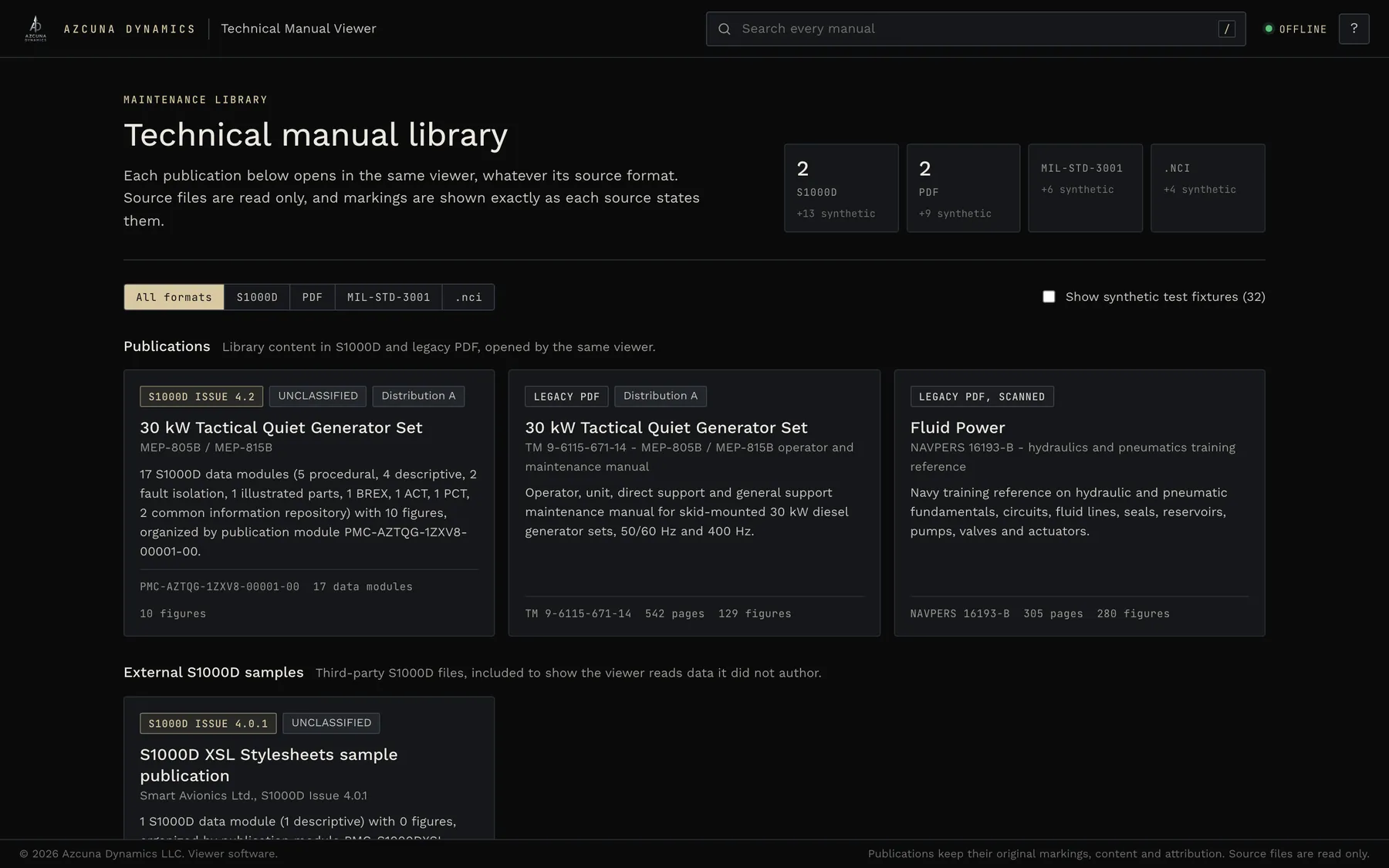
One library, every format
Every publication opens in the same viewer whatever its source format: the representative S1000D Issue 4.2 data set, the same generator's original 2000 PDF manual, a scanned 1970 Navy training reference, and a third-party S1000D sample the viewer did not author. Format filters cover S1000D, PDF, MIL-STD-3001 and .nci. Source files are read only.
Library home · format filters · synthetic fixtures hidden by default
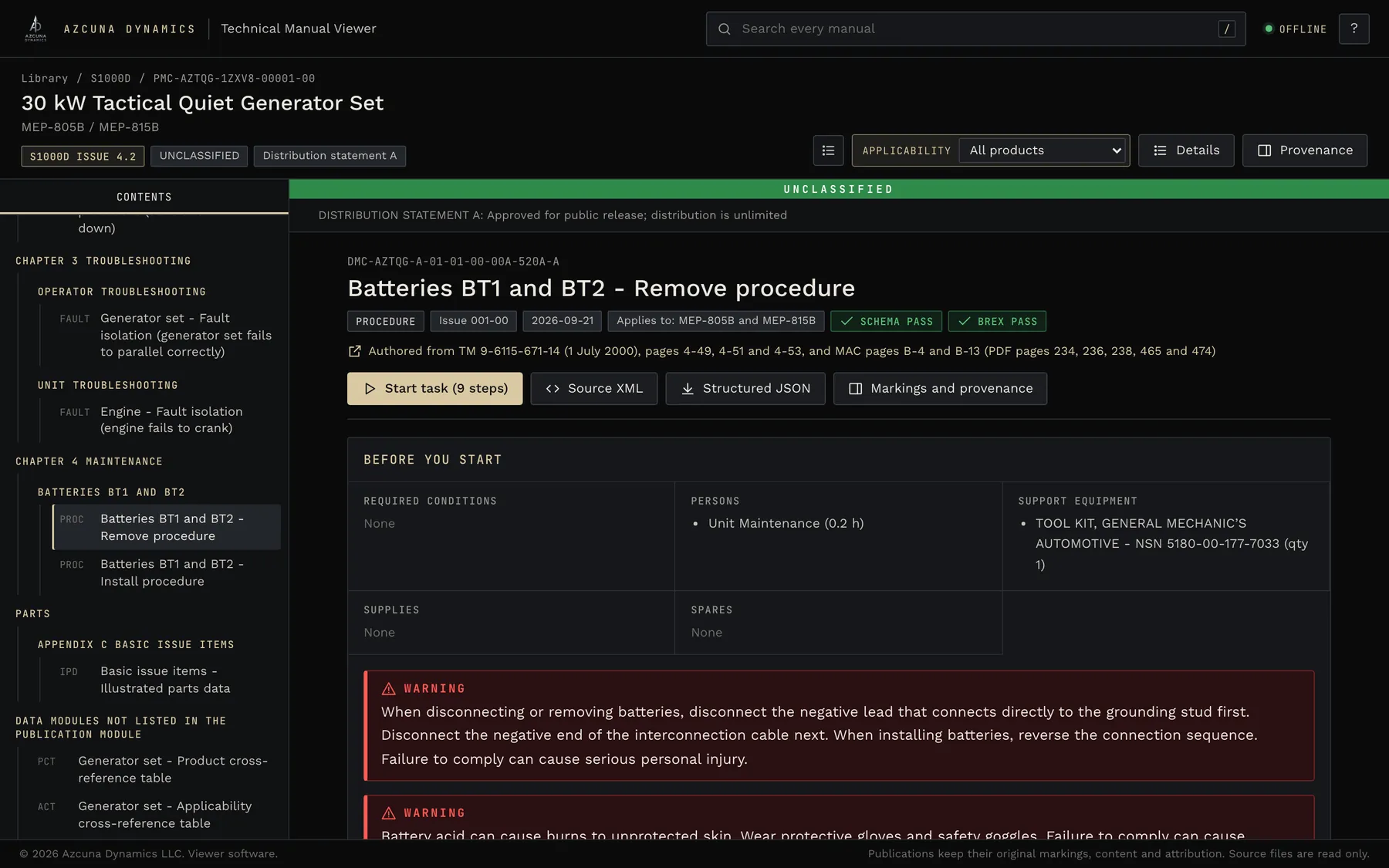
Warnings before the step
A procedure opens with its preliminary requirements, then every warning and caution the source attaches, before the first step. Schema and BREX results sit in the header, and the line under the title names the TM pages the data module was authored from.
S1000D procedure · schema pass · BREX pass · authored from TM 9-6115-671-14
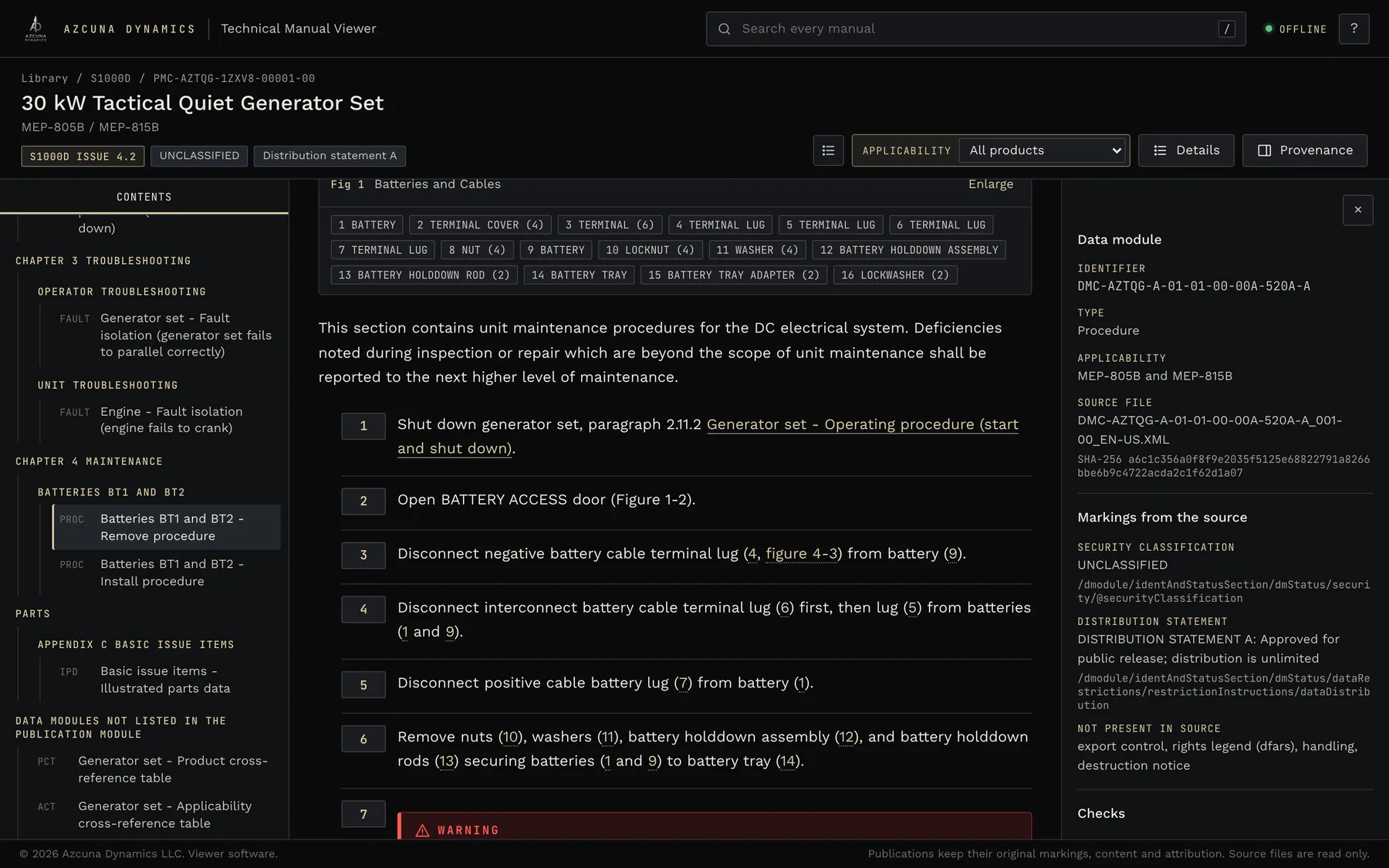
Provenance for every element
The provenance panel names the data module, its applicability, its source file with SHA-256, and every marking with the XPath it was read from. Legends the source does not carry are listed as absent rather than filled in.
Provenance panel · SHA-256 · markings with source element paths
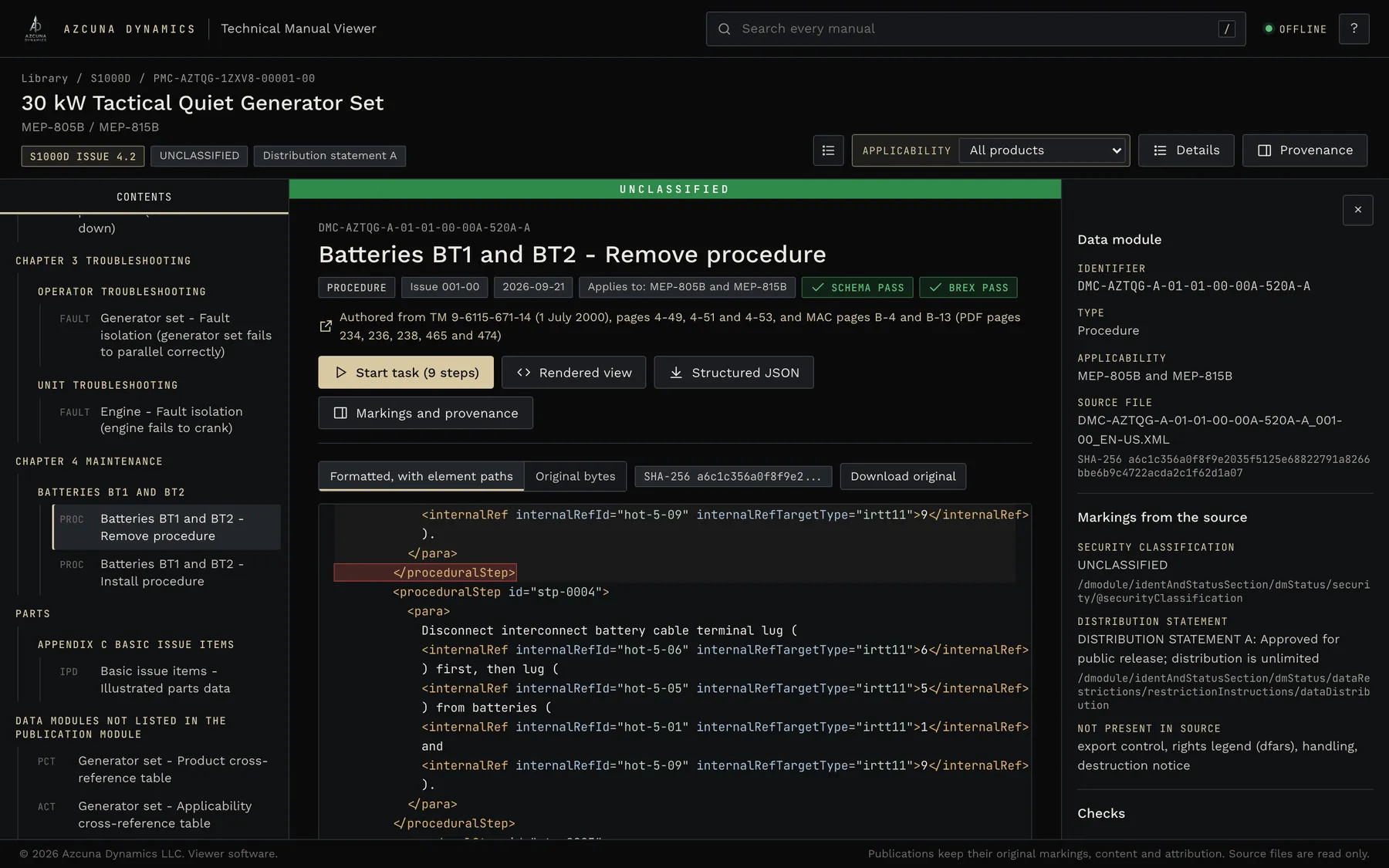
The source, unchanged
Source XML opens the original file with the selected step highlighted, formatted with element paths or as the original bytes, with the SHA-256 alongside. Nothing on screen is more than one click from the element it came from.
Source XML · proceduralStep[3] highlighted · original bytes · download original
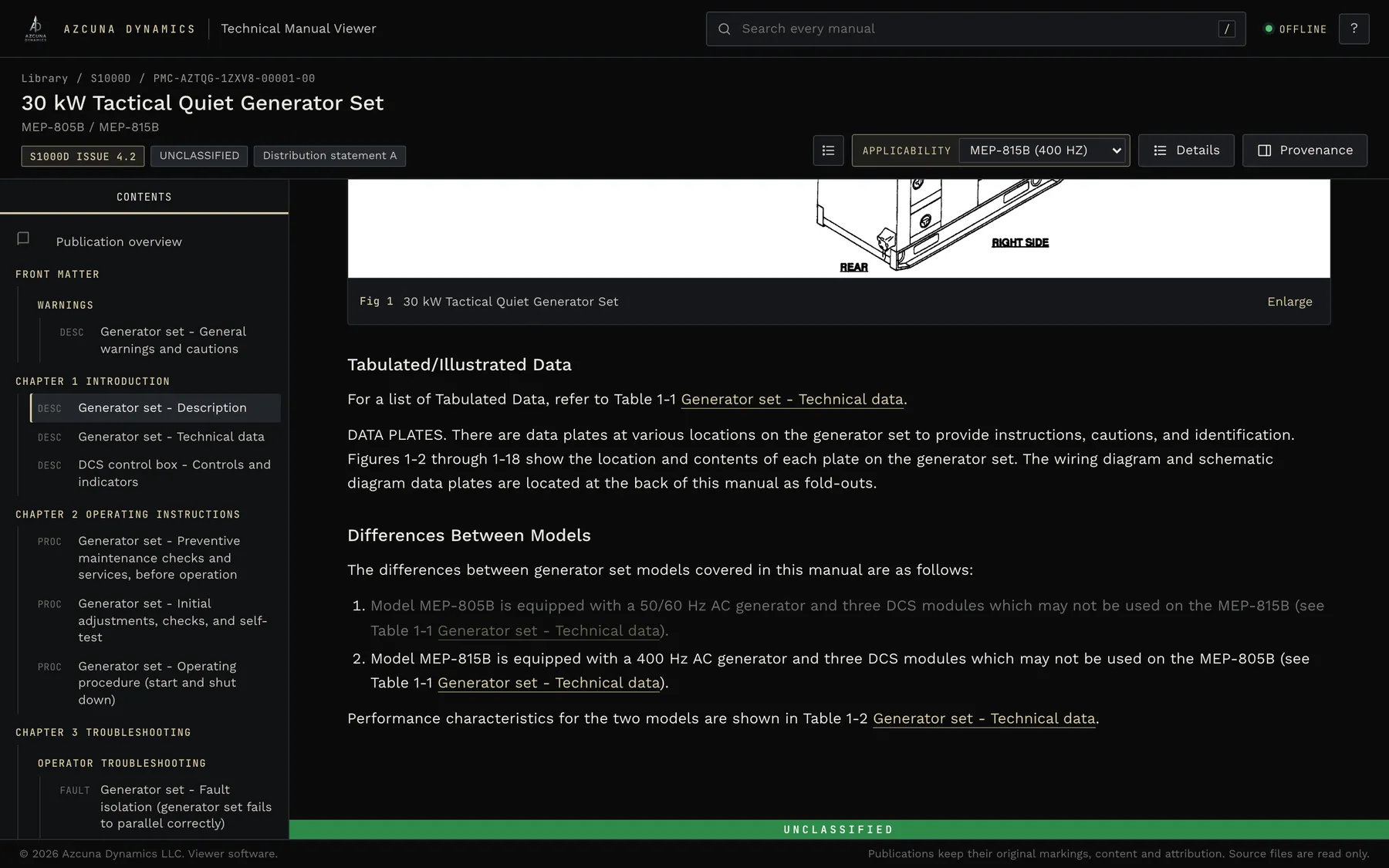
Applicability: marked, not hidden
Choose the MEP-815B and the content that applies only to the MEP-805B is dimmed, not removed. Applicability comes from the data set's own cross-reference tables, so the filter answers to the source rather than to the viewer.
Applicability filter · MEP-815B (400 Hz) selected · ACT and PCT data modules
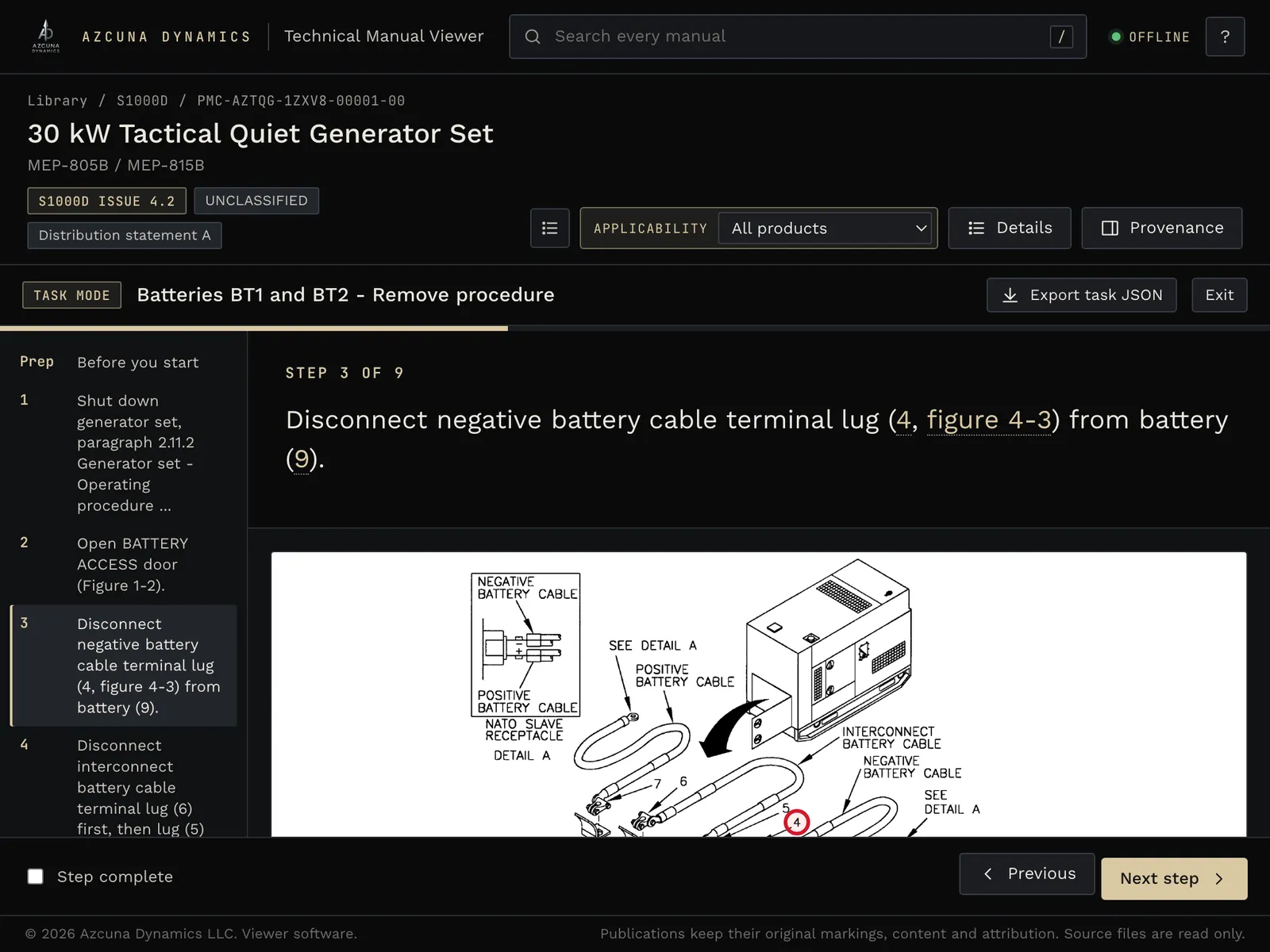
Task mode on a tablet
Step-at-a-time presentation for a tablet or headset. Warnings come first, the illustration sits beside the step with the callouts it cites lit, and the classification and distribution statement stay in view. Export task JSON hands the same ordered steps, precautions, graphics and markings to a step-presentation tool without rewording.
Task mode · step 3 of 9 · callouts 4 and 9 highlighted · export task JSON
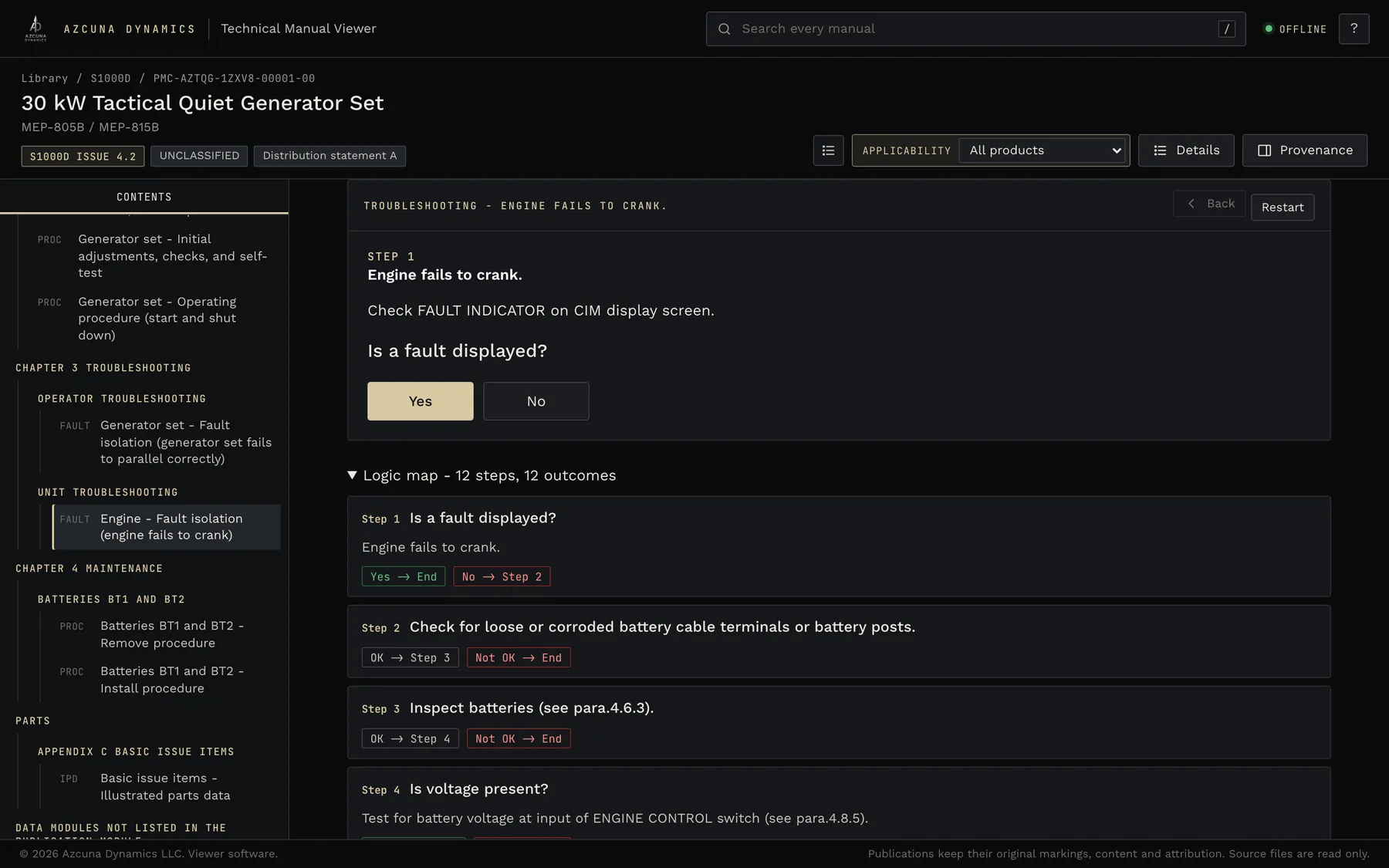
Fault isolation, one question at a time
Troubleshooting from the fault isolation data module runs one yes/no question at a time, records the path taken, and lists the full logic map, twelve steps and twelve outcomes, for review against the TM.
Fault isolation · engine fails to crank · logic map 12 steps, 12 outcomes
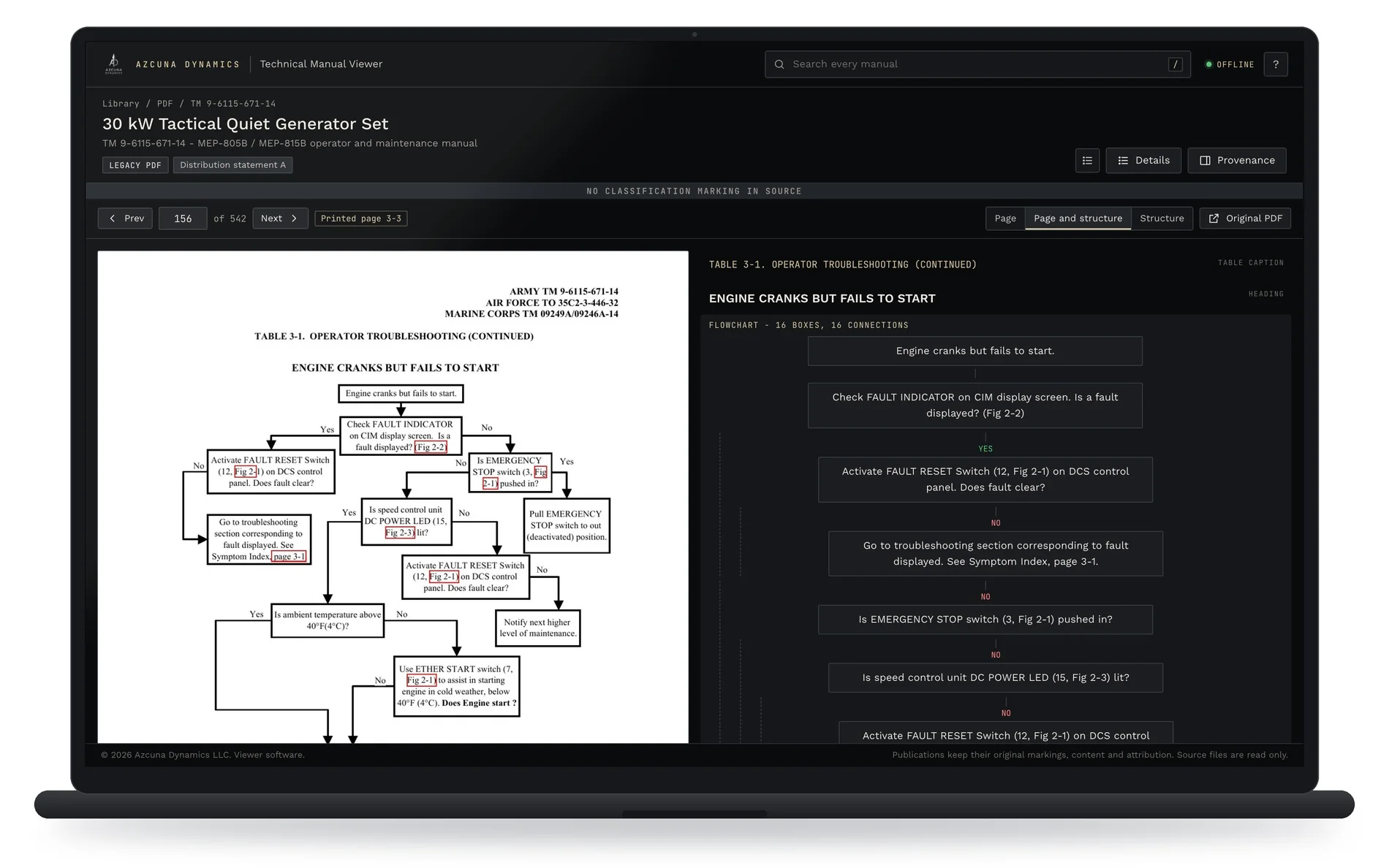
Legacy PDF beside its structure
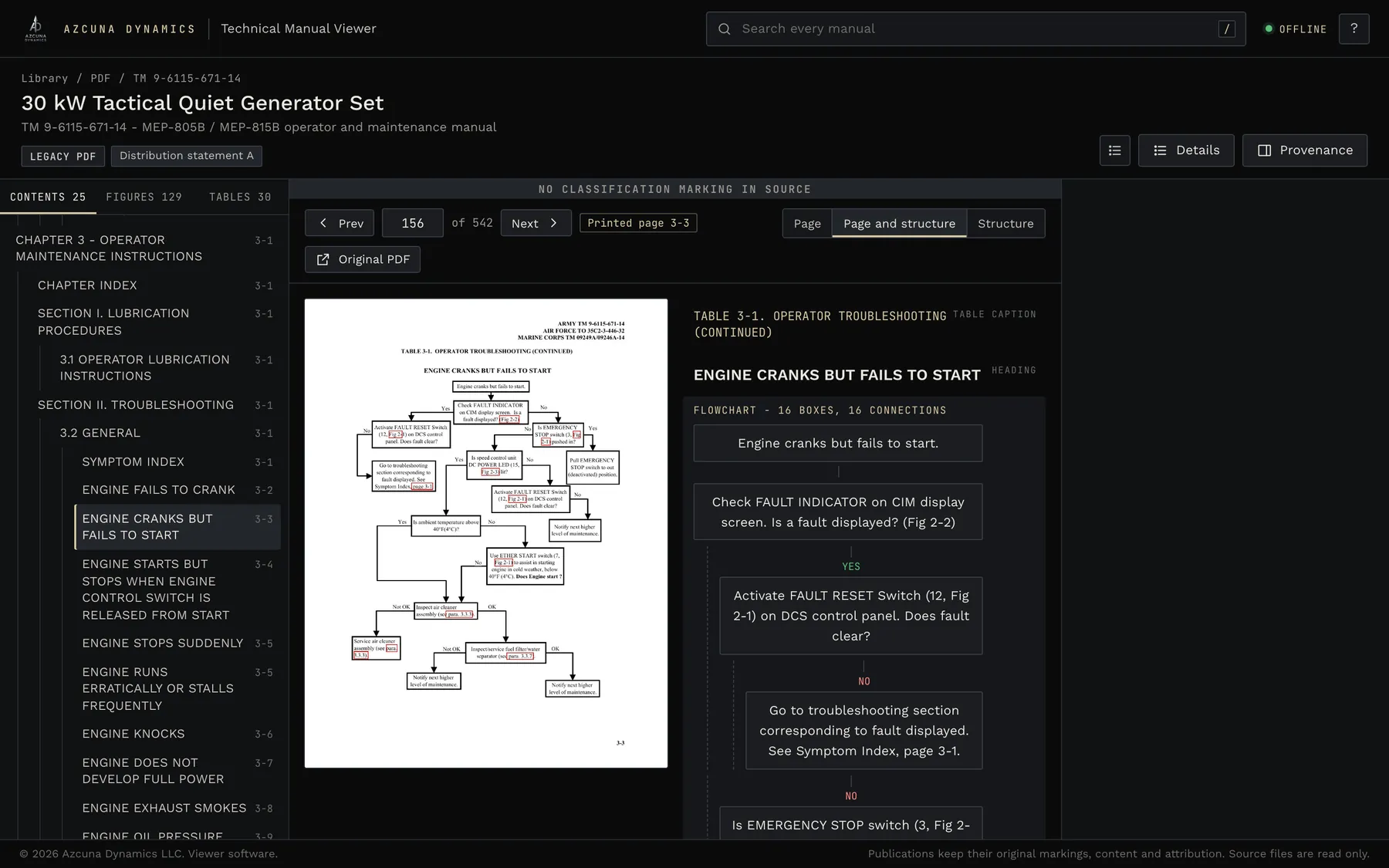
The unchanged TM page on the left beside the structure extracted from it on the right, here page 156 of 542 with the operator troubleshooting flowchart rebuilt as boxes and yes/no connections. Headings, warnings, tables and figure captions are typed as such, and the source PDF opens unchanged from the same screen.
Legacy PDF · page 156 of 542 · flowchart 16 boxes, 16 connections
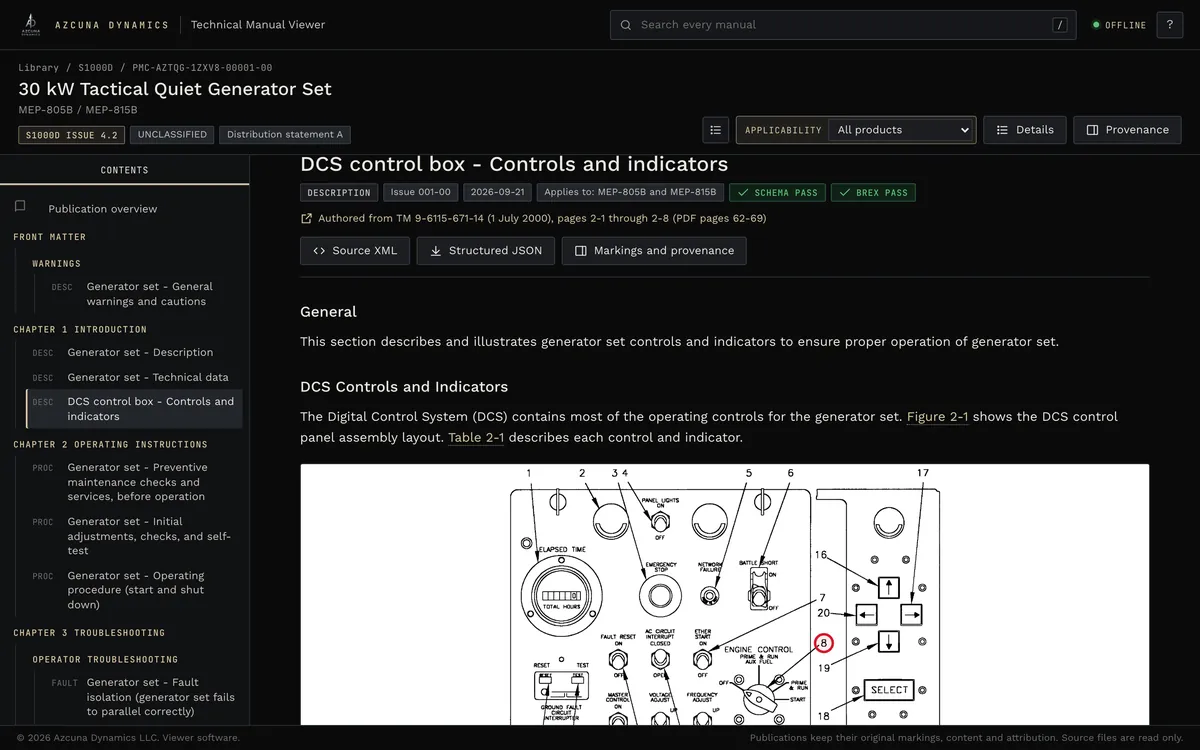
Hotspots come from the S1000D hotspot elements matched to ids in the SVG, never from coordinates typed into the viewer. Callout 8 lit from the table row that cites it.
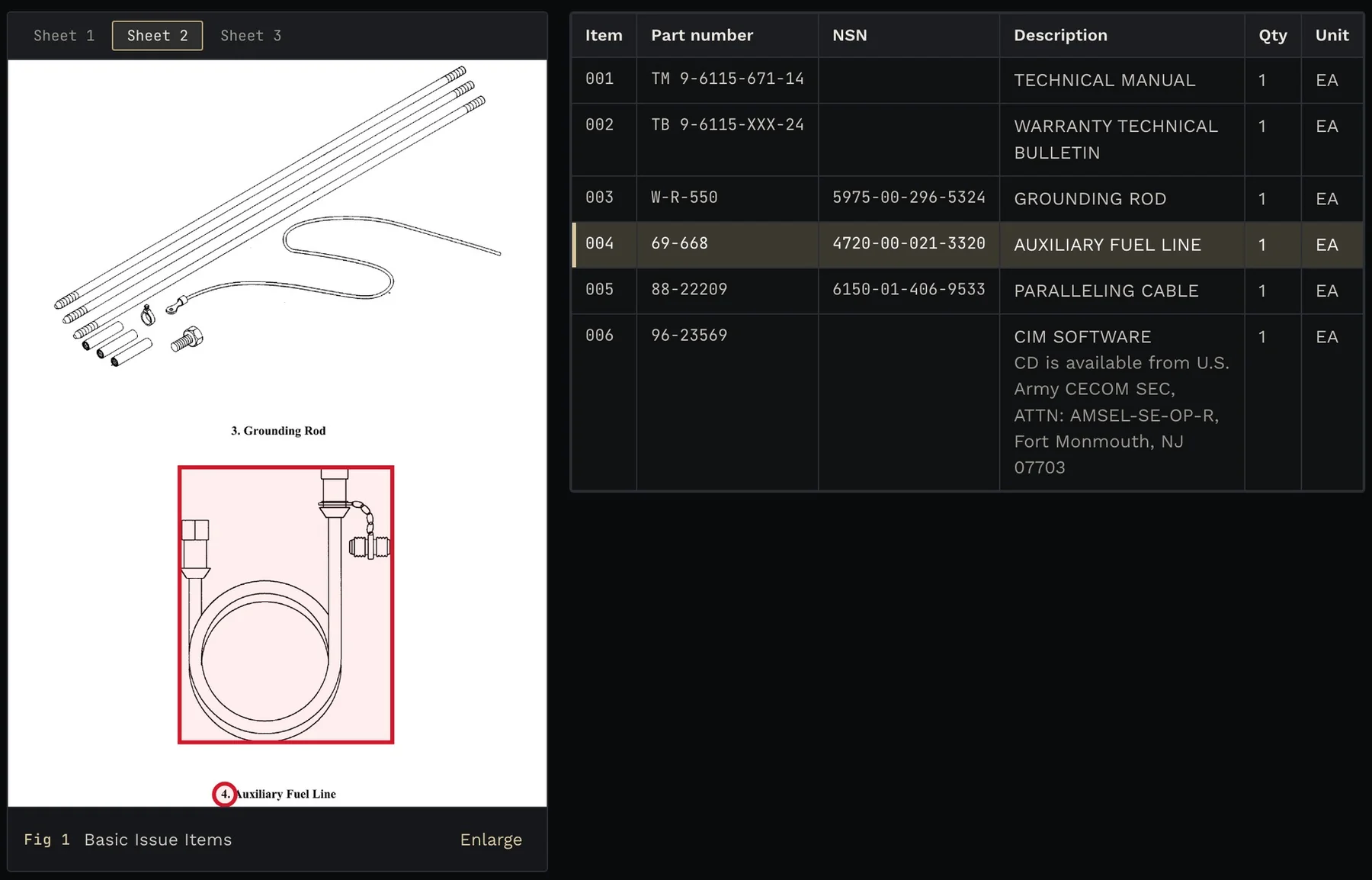
Selecting a parts row opens the sheet that shows the part and highlights its callout. Item, part number and NSN appear as printed.
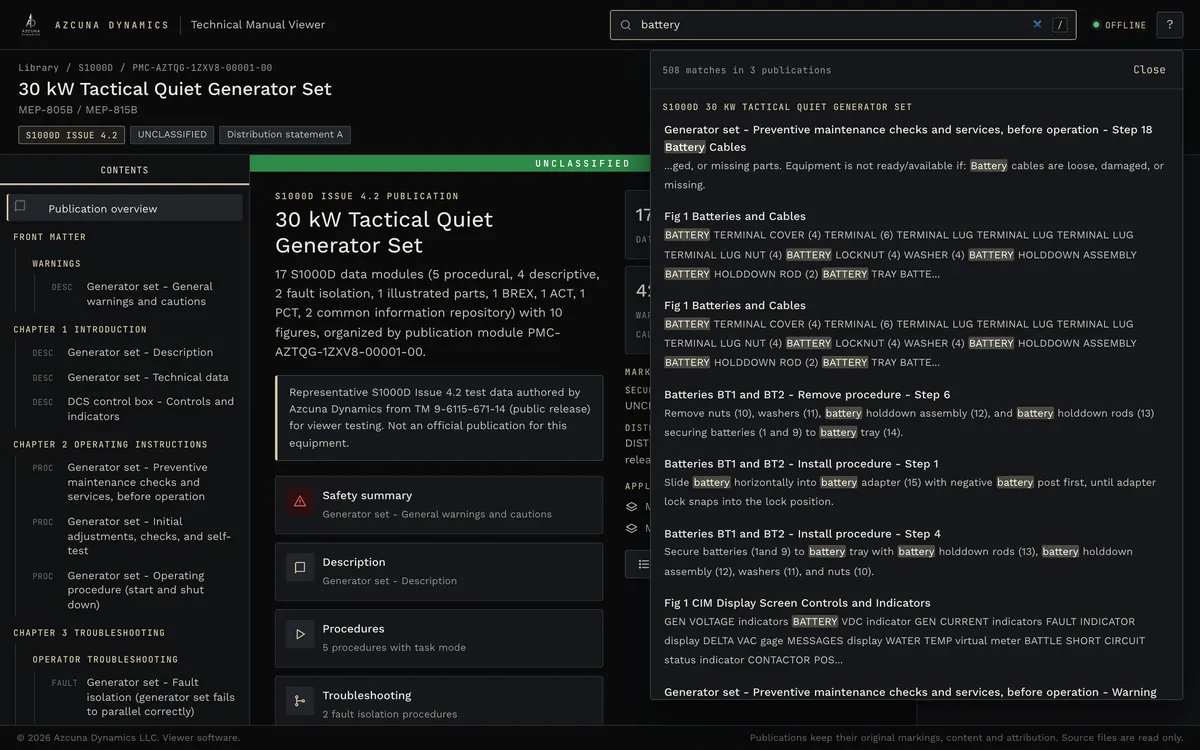
One query, 508 matches across three publications: S1000D steps, figure legends and PDF pages in one list.
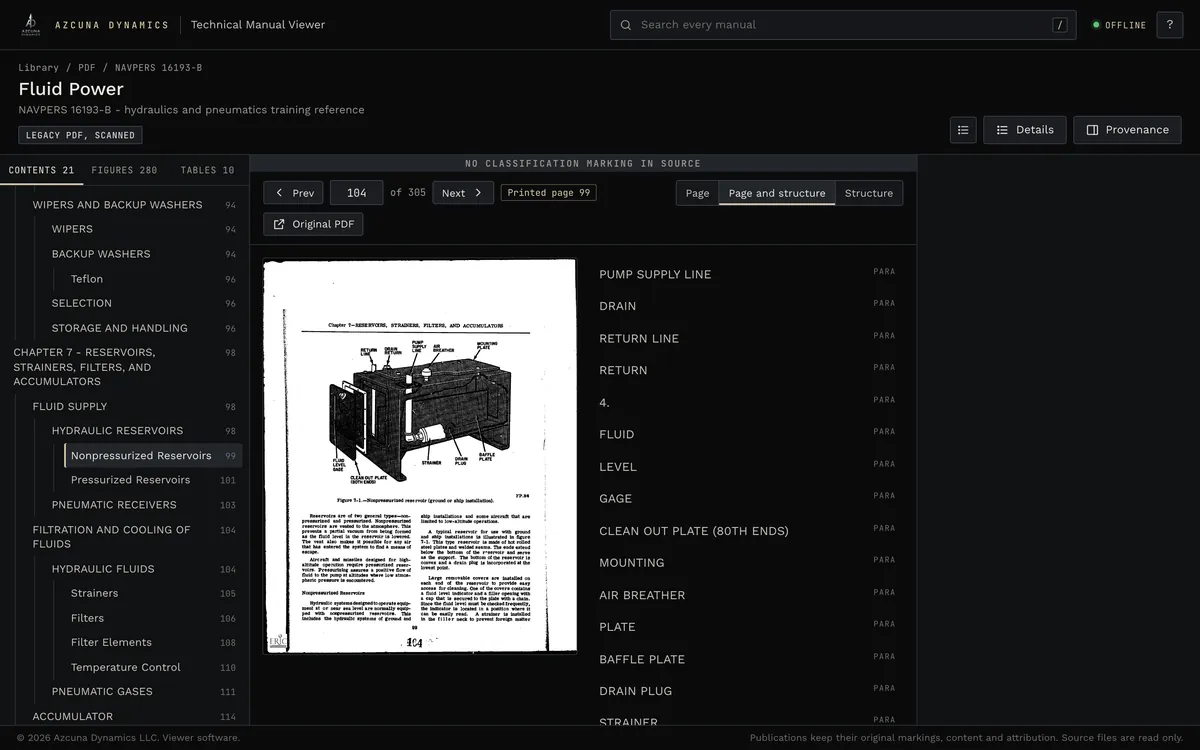
NAVPERS 16193-B, a scanned 1970 training reference, carries no classification or distribution marking. The viewer says so instead of inferring one.
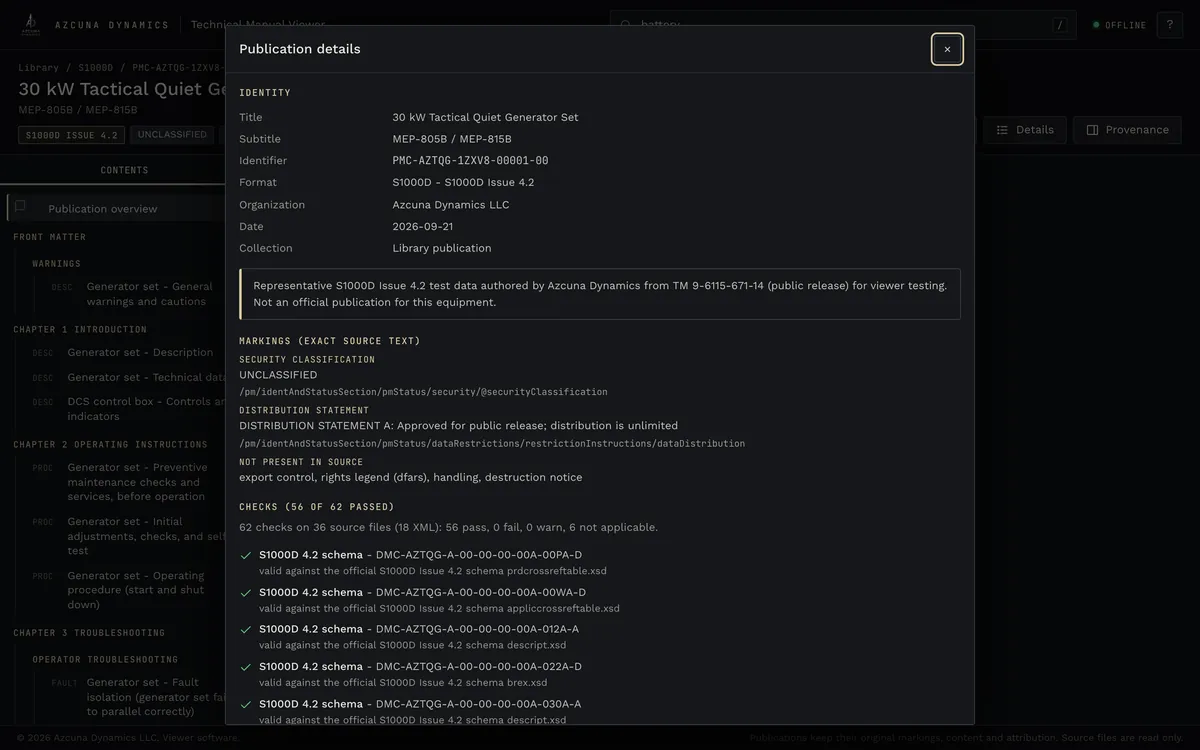
Publication details list each source file with its SHA-256 and each schema and BREX check with its result: 56 passed, 6 not applicable, none failed.
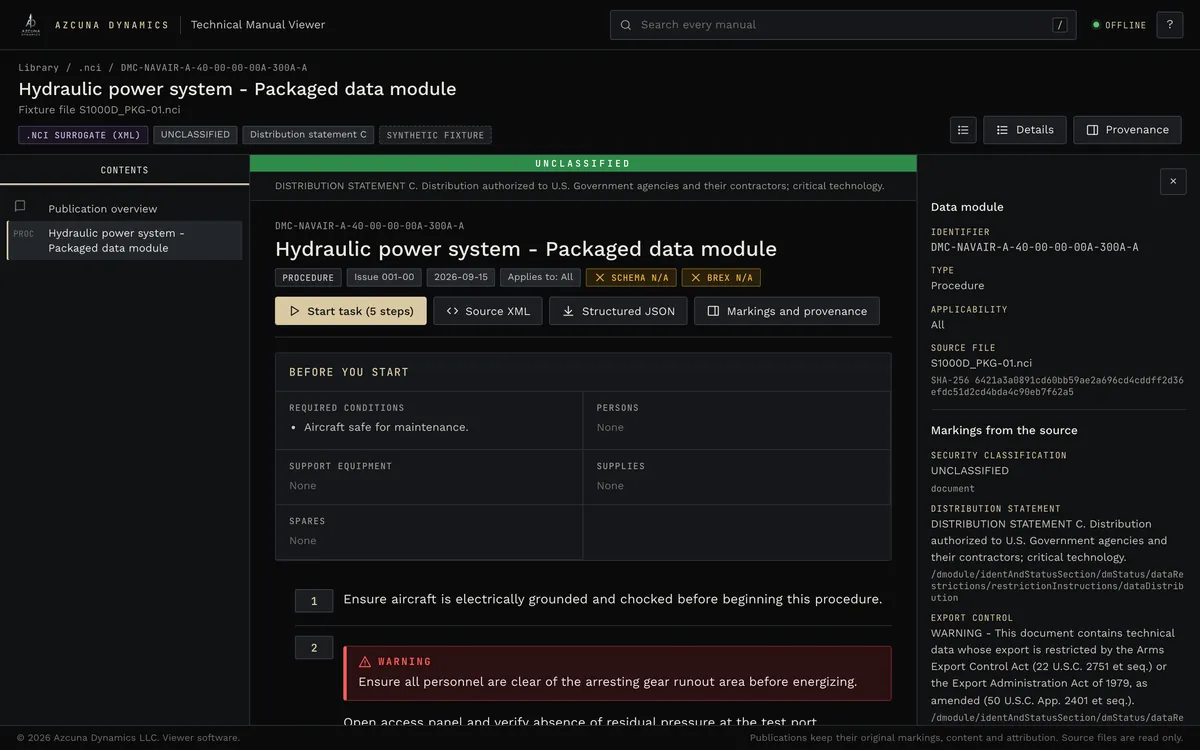
A synthetic test fixture carrying Distribution C, export-control, DFARS, handling and destruction legends, each shown with the source element it came from. Synthetic data, real behaviour.
The step, its graphic, its source element, and its markings, in one record.
Task JSON exported by the prototype for the battery removal procedure, trimmed to one step for length. A step-presentation, search, or AR/XR tool receives the ordered steps with their precautions, the illustration and the callouts to light, the file and XPath each step came from, and the publication's markings with the elements they were read from. Nothing is reworded.
schema azcuna.task/1 · 9 steps exported · excerpt shows step 3
{
  "schema": "azcuna.task/1",
  "publication": { "ident": "PMC-AZTQG-1ZXV8-00001-00", "format": "S1000D", "spec": "S1000D Issue 4.2" },
  "module": { "id": "DMC-AZTQG-A-01-01-00-00A-520A-A", "title": "Batteries BT1 and BT2 - Remove procedure" },
  "markings": {
    "classification": "UNCLASSIFIED",
    "distribution": "DISTRIBUTION STATEMENT A: Approved for public release; distribution is unlimited",
    "export_control": null, "dfars": null, "handling": null, "destruction": null,
    "source": {
      "classification": "/dmodule/identAndStatusSection/dmStatus/security/@securityClassification",
      "distribution": "/dmodule/identAndStatusSection/dmStatus/dataRestrictions/restrictionInstructions/dataDistribution"
    }
  },
  "steps": [
    {
      "number": "3",
      "applies": true,
      "text": "Disconnect negative battery cable terminal lug (4, figure 4-3) from battery (9).",
      "graphics": [ { "icn": "ICN-AZTQG-A-010100-A-1ZXV8-00005-A-001-01", "highlight": [ "hot-5-04", "hot-5-09" ] } ],
      "source": { "file": "DMC-AZTQG-A-01-01-00-00A-520A-A_001-00_EN-US.XML",
                  "xpath": "/dmodule/content/procedure/mainProcedure/proceduralStep[3]" }
    }
  ],
  "note": "Generated from the source data module without rewording. Markings travel with the task."
}Before submission and at private expense, Azcuna authored a publication module and 17 data modules from the public-release TM, validated all 18 against the official S1000D Issue 4.2 schemas and a project BREX, and pointed the same viewer at the original 542-page PDF for the same equipment.
From the PDF path alone the extractor typed 446 headings, 159 warnings, 71 cautions, 129 figures, and 69 troubleshooting flowcharts; on 13 flowchart pages checked against the page images, all 179 connections and their yes/no labels matched. A frozen-parser evaluation then parsed 83 public publications, NASA standards and handbooks, FAA publications, and openly licensed S1000D documentation, totaling 7,524 pages, and every model reconstructed with source hashes unchanged. The test harness ran under a sandbox that denied all network operations.
Constraint 1 · The source is never modified
The Navy asked for one viewer, not another converter. TRACE reads S1000D, MIL-STD-3001 XML, PDF, and OEM manuals as they are delivered, hashes each file before and after processing, and opens the unchanged original from the same screen. The authoritative publication stays authoritative.
Constraint 2 · Markings travel with the content
A display that drops a destruction notice or reorders a procedure is worse than no display. Distribution statements, export-control and DFARS legends, classification, handling, and destruction notices are separate fields on every element, with the scope they came from. Unmarked content is reported as unmarked, never inferred to be unrestricted.
Azcuna did not propose to design a multi-format viewer on paper. The prototype already reads schema-valid S1000D Issue 4.2 data and a 542-page legacy PDF manual for the same equipment, links each data module to the TM pages it was authored from, and exports ordered tasks with their precautions and markings. The privately funded BABEL work supplied the heterogeneous ingestion, local OCR, page-level provenance, and reproducible evaluation underneath it. Phase I therefore concentrates on what remains: the format and version baseline agreed with NAVAIR, the remaining adapters, a Government-reviewed measurement protocol, and the export demonstrated with two real consumers.
Format-specific behavior stays behind the adapter boundary. The model, the viewer, and the export never change when a format is added.
Pluggable adapters
One adapter per source format reads the file as delivered. S1000D data modules, MIL-STD-3001 XML, digital-native PDF, and OEM documents each enter through their own adapter, and every source is hashed before and after processing so nothing changes it.
Normalized content model
Sections, steps, warnings, cautions, notes, tables and cells, figures and callouts, cross-references, and applicability, in source order. Every element records the module or page it came from and the markings that govern it.
One viewer
A searchable library with format filters, a document outline, a procedure view, source-location inspection, and the original page beside the structure extracted from it. Warnings stay attached to the step they govern and appear before it.
Versioned export
The same ordered steps, references, and markings as a documented JSON contract for task search, query tools, and step presentation on a tablet or AR/XR headset. A consumer that drops provenance or markings fails the contract test.
A six-month Base that delivers a measured, fully offline viewer and export against a Government-reviewed protocol, followed by a six-month Option that bridges to Phase II Government data.
The topic's percentage figures are placeholders the Government said it would define together with the Phase I performer. Azcuna proposed to set units, denominators, severity classes, and acceptance criteria with the technical points of contact in Month 1, and to hold the prototype to these conditions.
- Every supported test file renders completely or receives an explicit, correctly classified rejection; no silent acceptance of unsupported content
- Zero loss, invention, or scope misattribution of required markings on supported fixtures
- Zero unresolved critical defects in procedural order, precaution placement, or figure association
- Exact equality between the export and the reconstructed model for content, relationships, provenance, and markings
- Coverage reported separately from fidelity, and results reported by format rather than as one aggregate percentage
- Evaluation set frozen before its first evaluation and kept apart from adapter-development data
TRACE stands for Traceable Reader for Any-Format Content and Export. It is an Azcuna Dynamics program: one offline viewer that reads S1000D data modules, MIL-STD-3001 XML, legacy PDF manuals, and OEM documents through a common content model, keeps every element tied to its source location and its markings, and exports the same structure for downstream tools. It was proposed to NAVAIR's NAWCAD Lakehurst under Navy SBIR topic DON26BZ05-NV078.
No. The topic's published Q&A asked for an agnostic viewer that reads existing formats rather than a converter to a new deliverable format, and stated that the Navy has several S1000D viewers and wants one. TRACE never modifies the authoritative source. The internal content model exists for rendering and integration, and the original file opens unchanged from the same screen.
S1000D Issue 4.x data modules and publication modules, with Issue 3 source analysis and a bounded representative path; MIL-STD-3001 XML; digital-native PDF, which also covers MIL-DTL-81310 content, with raster OCR as a supplementary path; and OEM manuals delivered as PDF or representative XML. Each format enters through its own adapter behind one interface, so adding a format does not change the viewer or the export.
They are preserved as distinct fields: distribution statement, export-control notice, data-rights legend, classification, handling, and destruction, each with the scope it came from, so one legend never overwrites another. A missing, conflicting, or low-confidence marking is an explicit validation condition. The viewer does not invent release authority and does not treat unmarked content as unrestricted.
A versioned JSON contract carrying content, relationships, source locations, effective markings, and validation status. Phase I demonstrates it with two reference consumers: deterministic task search and a procedure-sequence feed suitable for step presentation on a tablet or AR/XR headset. Consumers must honor the supplied restrictions, and contract tests catch dropped provenance, markings, or relationships.
No. The viewer is served from the local machine and its content-security policy permits no request outside that origin. The XML loader never fetches or expands external entities. That suits shipboard, flight-line, and other DDIL (denied, degraded, intermittent, and limited) conditions where a portable maintenance aid has no connection.
Public and representative material only: the public-release TM 9-6115-671-14 and the S1000D Issue 4.2 data set Azcuna authored from it, a standards-authored public S1000D example as the independent validation set, and representative MIL-STD-3001 and PDF sources with simulated markings. Government S1000D data, Navy BREX, and project business rules arrive in Phase II, as the topic Q&A specifies.
All three draw on the same privately funded document-ingestion, provenance, and evaluation work. BABEL is the multilingual platform, ELLMENT applies its retrieval core to E-2D mission crews, and TRACE applies the ingestion and provenance layer to technical manuals. TRACE displays source content with its provenance: every element on screen resolves to the page or data module it came from.
Phase II brings Government-furnished manuals, Navy BREX, and business rules, expands the library beyond one product, and adds automated validation and natural-language task query over the export. Phase III pursues operational integration and a maintainer comparison of task location time, navigation errors, source traceability, and critical omissions, consistent with the topic's test concept. The Q&A names the environments one viewer would serve: the NATEC and JEDMICS ecosystem for NAVAIR, and the SNIPP process with its Common Source Database for NAVSEA.
The literature cited in Navy SBIR topic DON26BZ05-NV078, the solicitation TRACE was proposed against.
- “The Interactive Electronic Technical Manual Overview: Setting the Stage”
Jorgensen, E.L.
Naval Surface Warfare Center, Carderock Division, CALS 1994
- “A Web-Based Architecture for Interactive Electronic Technical Manuals (IETMs)”
Jorgensen, E.L.; Fuller, J.J.
Defense Technical Information Center, ADA444772
- “MIL-DTL-24784C, Detail Specification: Manuals, Technical: General Acquisition and Development Requirements, General Specification for”
Department of Defense, 3 November 2007
Screens are captures of the internally funded prototype on public, unclassified source material (TM 9-6115-671-14 and NAVPERS 16193-B), plus one labelled synthetic test fixture. Phase I scope reflects the proposal as submitted to the Department of the Navy.