
Program · NIWC Pacific CSO N66001-26-S-C036
Sanctioned-Vessel Resolution: every ship checked against every sanctions list.
Sanctioned tankers change their names, flags and radio identifiers, and the seven official lists disagree about which ships are sanctioned. This console checks every broadcasting ship against all seven at once, keyed by the one number that stays with the hull, and uses radar to find the ships that stop broadcasting.
Built entirely on free, public data: the U.S., EU, UK, Swiss, Canadian, Australian and UN 1718 lists, Danish Maritime Authority AIS, and Copernicus Sentinel-1 radar and Sentinel-2 imagery. Every record it writes carries the result, every source used, and the rule and threshold that produced it.
This page describes a solution brief Azcuna Dynamics submitted to Naval Information Warfare Center Pacific in October 2026 under Commercial Solutions Opening N66001-26-S-C036. Everything shown is Azcuna's own privately funded work on public data.
Why one list is not enough
Screened against the U.S. list alone, 16 of these 21 hulls pass.
Every listed hull the console saw in Danish waters on 18 and 19 October 2026, and which of the seven authorities list it. No authority lists all 21. The register merges all seven by IMO number, so a ship listed anywhere is flagged everywhere, with each listing's date and legal basis.
| Hull, as broadcast | US | EU | UK | CH | CA | AU | UN |
|---|---|---|---|---|---|---|---|
| JASMINE 9354313 | |||||||
| ROZMARINE 9250531 | |||||||
| BOND 9412335 | |||||||
| EVENTIN 9308065 | |||||||
| FURIA 9257802 | |||||||
| GARNIZON 9297888 | |||||||
| HERA 9326720 | |||||||
| MELITE 9288710 | |||||||
| MIRES 9299771 | |||||||
| MYRA 9336490 | |||||||
| VELLAMO 9258882 | |||||||
| VIKRAM 9205067 | |||||||
| VIREL 9299874 | |||||||
| BIVOLA 9266865 | |||||||
| JIN HUI 9430272 | |||||||
| LERUO 9385831 | |||||||
| SILVERA 9248849 | |||||||
| WHITE CONDOR I 9255244 | |||||||
| DAKAR 9251743 | |||||||
| EVKLAZ 9402263 | |||||||
| TURMALIN 9470131 | |||||||
| Not listed by | 16 | 2 | 0 | 3 | 3 | 11 | 21 |
Try it · the identity check the console runs on every ship
Put in what a ship broadcasts. See what the lists say about it.
The console's own matching grades and identity flags, run in your browser against the full register. The first two are real broadcasts from 19 October 2026; the others show what happens to a mistyped IMO number, a borrowed name, and a ship on no list.
What the ship broadcasts on AIS
Loading 2,007 hulls…
Try it · the Sanctions Register, in your browser
Search by name and the rename beats you. Search by IMO number and it cannot.
All 2,007 hulls on the seven lists, as the console holds them. Try GARNIZON, the name one tanker broadcast off northern Denmark on 19 October, then its IMO number.
2,007 hulls from the seven official lists, downloaded 25 October 2026. Loads on first use and runs in your browser; nothing you type is sent anywhere.
Walkthrough · the console as it runs
Eight screens from the operator console, on one day of Baltic traffic.
Every capture is the working console replaying 19 October 2026 in the Danish straits, plus the Kharg Island watch. Ship names and listings are as published by the listing authorities.
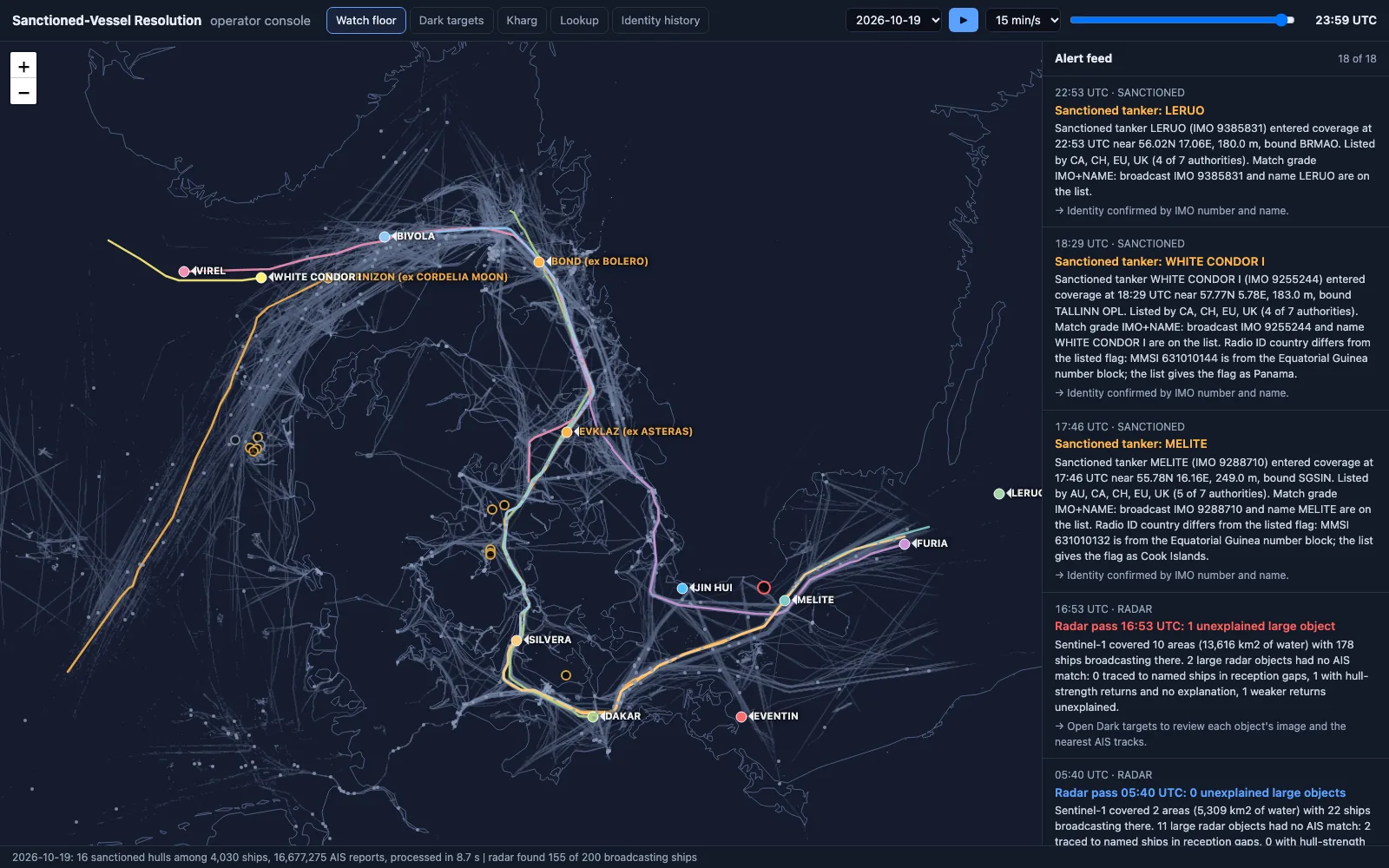
Every large ship in the Danish straits over 19 October 2026, with sanctioned tankers in orange and their tracks drawn. The alert feed explains each match in operator language.
- Watch floorSanctioned-Vessel Resolution · operator consoleoffline
Every large ship in the Danish straits over 19 October 2026, with sanctioned tankers in orange and their tracks drawn. The alert feed explains each match in operator language.
GARNIZON broadcasts IMO 9297888, which five authorities list as CORDELIA MOON. The IMO number stays with the hull through a rename, and the radio ID country differs from the listed flag. Each listing is shown with its date and legal basis.
Sentinel-1 radar objects with no AIS match, each with its image chip, size, signal strength and how many ships were heard nearby. One hull-strength object in Bornholm Gat had no explanation.
Tankers waiting off Iran's main oil terminal, counted on every radar and photo pass in 2026, with the spots held for 30 days or more. Berth counts come from photos, because radar cannot separate a moored tanker from the jetty.
- Analyst tools
Every sanctioned hull seen across the processed days: identities, listings, sightings, cargo cycles read from draught changes, meetings, fleet mates and what operators recorded.
An imagery request on the Bornholm Gat object and a flag-state query on GARNIZON, each written out with positions, scenes and listings so it can be sent as is.
Any IMO, MMSI, call sign or name against the register. A hull Switzerland de-listed in August 2025 reads as not sanctioned unless another list names it.
Resolution, revisit rate, collection frequency, latency and processing time, each with the figure measured in this build.
How a match is graded
The IMO number stays with the hull. Names and flags do not.
The broadcast IMO number is listed and the broadcast name matches a listed name for that hull.
The IMO number is listed but the name is not: a rename since listing, or an identity on loan.
The radio identifier or call sign is one a list publishes for that hull.
A listed name with no matching identifier. Never shown as a confirmed identification.
Identity and behavior flags, thresholds fixed before scoring
- Renamed since listing: a listed IMO number broadcast under a name on no list
- Radio-ID country differs from the flag the list gives
- Broadcast length differs from the listed length by more than 10%
- One MMSI on several IMO numbers, or one IMO on several MMSIs, in a day
- Broadcast IMO number fails its check digit
- Silent more than 2 hours with both ends inside dense coverage
- Positions implying more than 50 knots; set aside as jamming when 5+ ships nearby jump in the same hour
- Side by side with another ship under 1 knot for an hour or more, away from any harbour
How the numbers were measured
Throughput on full days of Danish AISThree full days, every report+
| Day | AIS reports | Ships | Processed in | Sanctioned hulls identified |
|---|---|---|---|---|
| 26 Jun 2026 | 36,095,232 | 13,827 | 18.0 s | 25 |
| 18 Oct 2026 | 16,826,371 | 4,015 | 8.6 s | 16 |
| 19 Oct 2026 | 16,677,275 | 4,030 | 8.6 s | 16 |
The registerSeven lists, one record per hull+
One record per hull, keyed by IMO number, built from the seven official publications on every run. Each designation keeps its authority, program or legal basis, listing date, stated reason, entry ID, source URL and download date. Every listed IMO number passes its check digit. Names are upper-cased, Cyrillic is transliterated, hull prefixes such as M/T are removed, and spelling-tolerant search allows one edit on names of six characters or more, ported from BABEL. De-listings are kept, so a hull removed by one authority reads as not sanctioned unless another list names it.
Radar ship detectionSentinel-1, 10 m, matched to AIS within 400 m+
A ship is a compact object at least 9 dB brighter than the sea around it, on open water, at least 3 pixels. Moving ships appear shifted along the satellite track, and the expected shift is applied before matching. Radar objects are matched to AIS ships placed at the moment their part of the scene was imaged. An unmatched object near a mapped turbine, buoy or platform is a fixed object; a large unmatched object with a hull-strength return is a dark-target candidate for an operator to review. On 19 October the radar found 155 of the 200 broadcasting ships in its scenes.
Kharg Island watch111 radar and photo passes in 2026+
Every Sentinel-1 pass and every usable Sentinel-2 photo over Iran's main crude terminal in 2026: tankers waiting by size class, spots held for 30 days or more, and same-day radar against photo. Berth counts come from photos, because radar cannot separate a moored tanker from the jetty.
What it is
- The product
- An operator console and service for maritime domain awareness: one sanctions register, graded matching of every broadcasting ship, identity and behavior flags, and radar detection of ships that are not broadcasting. Runs as a desktop app or a local service.
- Who uses it
- Maritime domain awareness watch floors, sanctions enforcement and intelligence analysts, and the partner nations they share evidence with. Outside government: insurers, port operators and commodity traders screening counterparties.
- What goes in
- The seven official sanctions lists, refreshed on every run; AIS position reports, historical or live; Sentinel-1 radar and Sentinel-2 imagery. All public.
- What comes out
- Alerts in operator language, one case file per hull, one-page evidence packets, taskings with the evidence written out, a shift handoff, and the same data as a REST API, S3 snapshots and a TCP stream.
- What every record carries
- The result, every source used (list entries, AIS reports, image scenes), and the rule and threshold that produced it.
Program facts
- Vehicle
- Commercial Solutions Opening
- CSO
- N66001-26-S-C036
- Sponsor
- Naval Information Warfare Center Pacific
- Status
- Solution brief submitted October 2026
- Lists
- OFAC SDN, EU Reg. 833/2014 Annex XLII, UK, SECO, SEMA, DFAT, UN 1718
- Tracking
- AIS from the Danish Maritime Authority; a live feed slot for aisstream.io
- Imagery
- Copernicus Sentinel-1 radar (10 m) and Sentinel-2 photos
- Operator layer
- Dispositions, watchlist, taskings, case files, shift handoff, audit trail
- Outputs
- One-page evidence packets, REST API, S3-layout snapshots, TCP stream
- Runtime
- Desktop app or local service; every source is a public file
Related program · BABEL
Cyrillic and Latin ship names, read the same way.
The register's transliteration and spelling-tolerant name search come from BABEL, Azcuna's offline engine for foreign-language documents.
Program FAQ
It checks every ship broadcasting in an area against 2,007 sanctioned hulls on seven official lists, tests each ship's broadcast identity against what the lists say, and uses radar to find ships that are not broadcasting.
A ship's IMO number stays with the hull for life. Names, flags and radio identifiers change, and sanctioned tankers change them often. The console grades every match by which identifiers agree and never shows a name-only match as a confirmed identification.
Seven official sanctions publications (U.S. OFAC, EU, UK, Switzerland, Canada, Australia and the UN 1718 Committee), AIS published by the Danish Maritime Authority, and Copernicus Sentinel-1 and Sentinel-2 scenes. All of it is free and public.
A full day of Danish AIS, 16.7 million reports from 4,030 ships, is matched with identity and behavior flags in 8.6 seconds. A radar pass is triaged in about 30 seconds.
Maritime domain awareness watch floors, sanctions enforcement analysts, and partner nations that share evidence packages.
It is the subject of a solution brief submitted to NIWC Pacific in October 2026. Everything on this page is Azcuna Dynamics' own privately funded work on public data.
Sources
- Specially Designated Nationals List
U.S. Treasury, OFAC · ofac.treasury.gov
- Regulation (EU) 833/2014, Annex XLII (vessels, Article 3s)
European Union · eur-lex.europa.eu
- The UK Sanctions List
United Kingdom, FCDO · gov.uk
- Sanctions and embargoes, consolidated list
Switzerland, SECO · seco.admin.ch
- Consolidated Canadian Autonomous Sanctions List
Canada, Global Affairs · international.gc.ca
- Consolidated List
Australia, DFAT · dfat.gov.au
- 1718 Committee Designated Vessels List
UN Security Council · un.org
- Historical AIS data
Danish Maritime Authority · aisdata.ais.dk
- Sentinel-1 and Sentinel-2 data
European Union, Copernicus · dataspace.copernicus.eu
Screens, figures and the register come from the internally funded console on public data: the seven official sanctions lists downloaded 25 October 2026, Danish Maritime Authority AIS, and Copernicus Sentinel-1 and Sentinel-2 scenes. Ship names and listings are as published by the listing authorities.