
Program · ERDC BAA W912HZ26S0001, topic CHL-22
Manual Update Workbench: dam manual drafts where every sentence has a source.
Federal law now requires Forecast Informed Reservoir Operations (FIRO) in every Army Corps water control manual update where practicable. The Workbench is the desk tool for the district engineer who has to write those updates, and the deviation requests that come first.
The engineer loads the manual, the viability assessment and the Engineer Regulations, works through the operating rules page by page, records the plan choice, and exports a Word draft in which every sentence carries a footnote to the page it came from. The same quote check that runs LEDGER decides what reaches the draft. It runs on one computer with no network connection.
This page describes a pre-proposal Azcuna Dynamics submitted to the U.S. Army Engineer Research and Development Center in October 2026 under BAA topic CHL-22. Everything shown is Azcuna's own privately funded work on public documents.
Why the Corps needs this
Hundreds of dams cleared for FIRO. One manual signed so far.
of the Water Resources Development Act of 2024 directs USACE to incorporate FIRO in manual updates “to the maximum extent practicable.”
USACE-regulated dams came through ERDC's FIRO screening with no prohibitive barrier. Each viable site leads to a manual update.
for FIRO research in the FY2026 joint explanatory statement, which asks how FIRO gets into manual updates nationally.
Lake Mendocino's manual, the first with FIRO, was signed after years of deviations and a $0.80 million task order.
Until a manual changes, every FIRO season runs on a deviation request that must carry 12 items, including a risk and uncertainty analysis (ER 1110-2-240, para. 3-4c). Every one of those documents restates rules, numbers and dates already printed somewhere in the record. The Workbench finds them, quotes them exactly, and shows the reviewer the page.
Try it · the quote check, in your browser
Try to slip a wrong number past it.
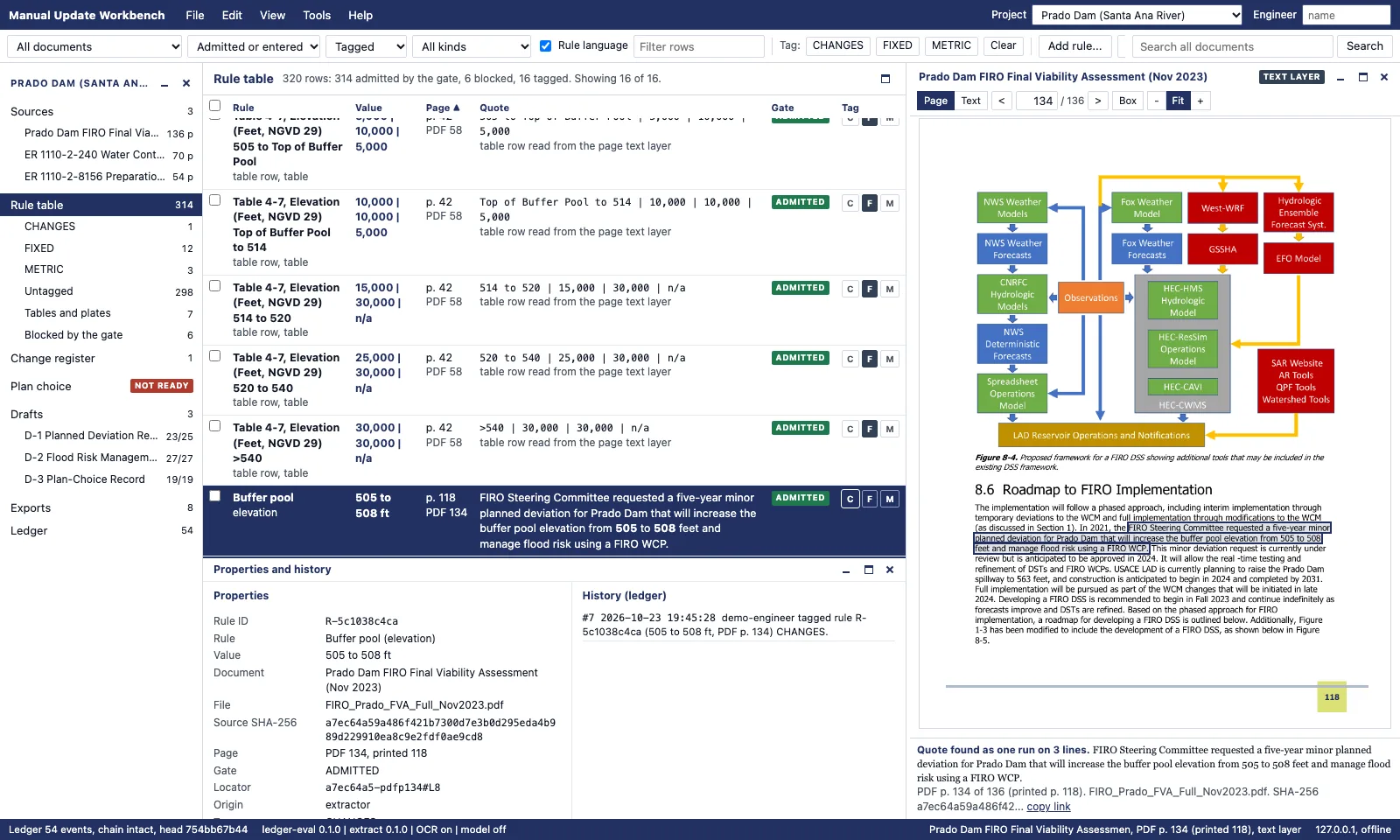
On the left is the real text of report page 118 of the Prado Dam viability assessment. Write a sentence for the draft and the quote it cites. The prototype's own rule decides: the quote must be on the page word for word, and every number in the sentence must be in the quote.
8.6 Roadmap to FIRO ImplementationThe implementation will follow a phased approach, including interim implementation through temporary deviations to the WCM and full implementation through modifications to the WCM (as discussed in Section 1). In 2021, the FIRO Steering Committee requested a five-year minor planned deviation for Prado Dam that will increase the buffer pool elevation from 505 to 508 feet and manage flood risk using a FIRO WCP. This minor deviation request is currently under review but is anticipated to be approved in 2024. It will allow the real -time testing and refinement of DSTs and FIRO WCPs. USACE LAD is currently planning to raise the Prado Dam spillway to 563 feet, and construction is anticipated to begin in 2024 and completed by 2031. Full implementation will be pursued as part of the WCM changes that will be initiated in late 2024.
text layer · SHA-256 a7ec64a59a486f42…
quote found word for word on PDF p. 134 (printed p. 118); every number is in it
- The quote is at least 4 words
- The quote is on the page, word for word
- Every number in the sentence is in the quote (505, 508)
Edit either box. The check is the prototype's own rule, run in your browser on the page's text layer.
One rule, from the page to the footnote
Every sentence in the Word file can be walked back to its page.
- 01On the page
FVA PDF p. 134 · printed 118
“FIRO Steering Committee requested a five-year minor planned deviation for Prado Dam that will increase the buffer pool elevation from 505 to 508 feet…”
- 02In the rule table
R-5c1038c4ca · ADMITTED · CHANGES
Buffer pool (elevation): 505 to 508 ft. Tagged as a rule the update changes; current 505, proposed 508.
- 03In the draft
Planned Deviation Request · Item 1
“The viability assessment states: ‘FIRO Steering Committee requested a five-year minor planned deviation for Prado Dam…’”
- 04In the footnote
Word export · footnote 3
Prado Dam FIRO Final Viability Assessment (Nov 2023), PDF p. 134 (printed p. 118): “FIRO Steering Committee requested…” SHA-256 a7ec64a59a48.
Walkthrough · the prototype as it runs
Twelve screens from one Prado Dam session, on public documents, offline.
Every capture is the working prototype reading the Prado Dam FIRO Final Viability Assessment (November 2023), ER 1110-2-240 and ER 1110-2-8156, plus the Lake Mendocino 2019 deviation request.
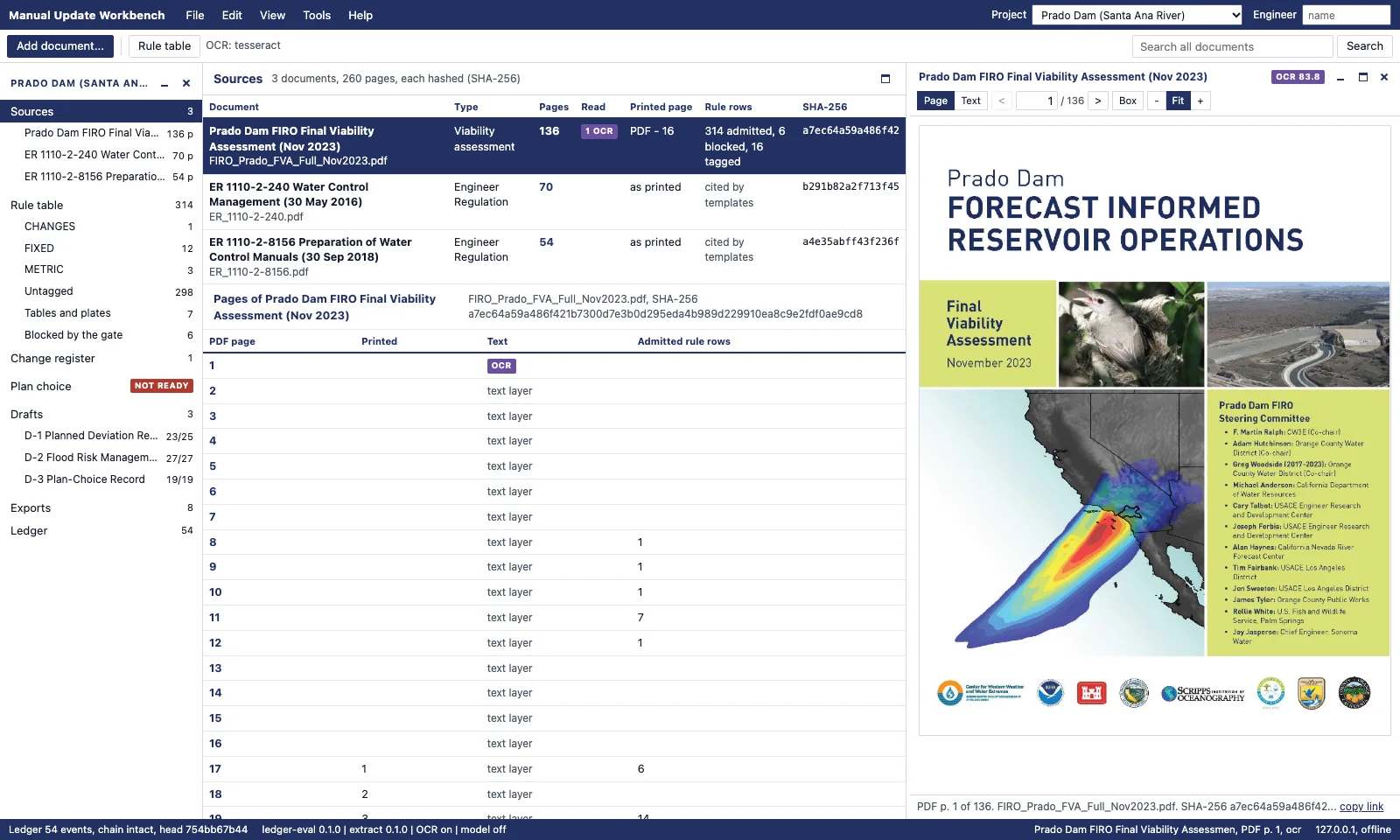
The viability assessment and both Engineer Regulations, each hashed with SHA-256 and split into page text and page images. Printed page numbers are read from the footers, so the app knows report page = PDF page minus 16.
- Sources and rulesManual Update Workbench · Prado Damoffline
The viability assessment and both Engineer Regulations, each hashed with SHA-256 and split into page text and page images. Printed page numbers are read from the footers, so the app knows report page = PDF page minus 16.
The 505 to 508 ft buffer pool deviation, admitted by the quote check and shown boxed on report page 118. The row's ledger history sits underneath.
Table 4-7, the Prado maximum release schedule, read from the page text layer. Each row is admitted only if the table label is printed on the page and the row still reads the same on every check.
Lake Mendocino guide-curve values read off Figure 3. They are never called admitted: the status is ENTERED and the person who typed them is named.
- Plan choice
FVA Table 5-1, 11 viable alternatives and 132 values, shown next to the printed page it came from. Excluding an alternative needs a written reason.
Which alternative leads as one priority group's weight runs from 0 to 1. The steering committee's recommended range holds the top three places under equal group weights.
Readiness is computed, not asserted. Prado reads NOT READY because study metric M12 has no value in the assessment. Replay re-scores the stored inputs and matches the recorded SHA-256.
- Drafting
The cited words are on the page but split across table columns. The viewer shows the pieces dashed; a person splits the citation or releases it with their name.
A sentence saying FIRO eliminates spillway flow for all scaled events. The words are not on the page together, so it is blocked with the reason shown and never reaches the Word file.
- Export and record
Every action is a hash-chained event. Verify and replay reads the ledger back from disk and re-scores every recorded run; editing any past event is detected.
The exported Prado planned deviation request: every sentence followed by its own footnote, each footnote naming the document, page, quote and SHA-256.
One trace row per citation: footnote, source, page, quote or record fact, and hash. The file is reopened and checked after it is written.
Checked against the Corps' own record
The earlier record already held 7 of the signed manual's 9 rules.
The Corps' Final Environmental Assessment for the 2025 Lake Mendocino manual sets out its operating rules. The prototype admitted all 9 quotes from it, then looked each one up in the rule table it had built from the public record that came before: the 2017 deviation request and letter and the 2020 viability assessment. The two rules the manual changed are exactly the two that appear on no earlier page.
| Rule | Signed manual (EA, 2025) | Earlier record | Result |
|---|---|---|---|
| Encroachment into flood control space | 11,650 ac-ft | 11,650 (2017 request p. 4; FVA p. 62) | Same value |
| Maximum flood-season storage | 80,050 ac-ft | 80,050 (2017 letter p. 2; FVA p. 41) | Same value |
| Flood season start | October 23 | November 1 (2017 request p. 4) | Changed in the manual |
| Spring refill start | February 15 | February 15 (FVA p. 115) | Same value |
| Spring refill rate | about 355 ac-ft/day | 436 ac-ft/day (2017 letter p. 2; FVA p. 62) | Changed in the manual |
| Top of conservation at end of refill | 111,000 ac-ft | 68,400 to 111,000 (2017 request p. 3) | Same value |
| Forecast basis | 5-day deterministic, NWS | FVA p. 42, Five-Day Deterministic plan | In the record, as text |
| Release trigger | 15,000 ac-ft 5-day inflow | 15,000 ac-ft, Trigger 1 (FVA p. 42) | Same value |
| Pre-releases into conservation space | if FIRO tools recommend, with approval | same wording (FVA p. 108) | In the record, as text |
9 of 9 EA quotes admitted: 5 same value, 2 in the earlier text as written rules, 2 changed and on no earlier page. Each source page is checked against hashes taken from the published PDF.
Try it · the plan choice
Move a priority. Watch which plan leads.
The Prado viability assessment scores 11 viable alternatives on 12 metrics in Table 5-1 and publishes no weights. The Workbench makes the weights a recorded, locked decision and shows how close the call is: at equal weights the top three sit within 0.0043 of each other, all inside the steering committee's recommended 510 to 512 ft range.
Leads under these weights
512-EFO
Score · margin over 512-SFO
0.707356 · 0.004277
Which plan leads as one priority runs from 0% to 100%
- 512-EFO0.7074
- 512-SFO0.7031
- 510-SFO0.7030
- 514-EFO0.7008
- 508-SFO0.6943
- 510-EFO0.6903
- 508-EFO0.6864
- 514-SFO0.6852
- WCM base0.4978
- 520-EFO0.4641
- 520-SFO0.3285
FVA Table 5-1, 543-ft spillway: 11 viable alternatives and the current manual (WCM), 12 metrics. Excluded with the FVA's stated reason: 508-NF, 510-NF, 512-NF, 514-NF, 520-NF. Equal group weights reproduce the recorded run bit for bit. Weights here are for exploration; the decision belongs to the District.
Four verdicts, re-run on every edit
Only three of them reach the Word file.
Every cited quote is on its page word for word, and every number in the sentence appears in a cited quote.
The words are on the page but a line break or table column splits them. Held until a person splits it or signs for it.
Values a person read off a drawn plate. Goes into the Word file with a footnote naming who entered it, never called a quote.
Anything else, with the reason shown. A blocked sentence never reaches the Word file.
What it is
- The product
- Desktop software for one district engineer: load the sources, map the operating rules, record the plan choice, export traced Word drafts. Runs on one computer with no network connection.
- Who uses it
- U.S. Army Corps of Engineers district water control engineers writing FIRO manual updates and deviation requests, and the architect-engineer firms the districts hire for that work.
- What goes in
- The current water control manual, the FIRO viability assessment, prior deviation requests and letters, and the governing Engineer Regulations, as PDFs. Scanned pages are read by OCR and flagged.
- What comes out
- Word drafts of the planned deviation request (ER 1110-2-240, 12 items), the gate-opening decision process (ER 1110-2-8156), and a plan-choice record, each sentence footnoted to its page, plus the rule table, change register and ledger as CSV.
- What it never does
- Fill an item no admitted source supports. Those stay open for the people who own them, such as the PFMA review and the District commander's recommendation.
Program facts
- Vehicle
- ERDC Broad Agency Announcement
- BAA
- W912HZ26S0001, topic CHL-22
- Sponsor
- U.S. Army Engineer Research and Development Center
- Status
- Pre-proposal submitted October 2026
- User
- USACE district water control engineer
- Output
- Word drafts with one footnote per sentence, plus a source-trace appendix
- Templates
- Planned deviation request (ER 1110-2-240), gate-opening decision process (ER 1110-2-8156), plan-choice record
- Quote check
- LEDGER admission gate: verbatim quote, cited page, every number in the quote
- Record
- Hash-chained ledger of every action; replay re-scores every run
- Runtime
- One computer, local web app, no network connection
Related program · LEDGER
The same engine, applied to Army acquisition decisions.
The Workbench's quote check, scoring, switching values, readiness and ledger are the LEDGER core, used unchanged. LEDGER runs them on ground-vehicle trade studies.
Program FAQ
It helps a Corps district engineer draft the FIRO sections of a water control manual update and the deviation requests before it, in Word, with every sentence footnoted to the page it came from and checked word for word.
Section 1162 of the Water Resources Development Act of 2024 requires Forecast Informed Reservoir Operations to be considered in water control manual updates, and ERDC BAA topic CHL-22 asks for research to support those updates. The first FIRO manual, Lake Mendocino, was signed in October 2025.
No. It pre-fills each section from the rules the engineer tagged and the recorded plan choice, and leaves open every item no admitted source can fill, such as the District commander's recommendation. The engineer writes and signs.
The rule extractor and the quote check are deterministic code. The prototype runs with the model off; the status bar says so.
No. It runs as a local web app on one computer and calls no hosted service.
It is the subject of a pre-proposal submitted to ERDC in October 2026. Everything on this page is Azcuna Dynamics' own privately funded work on public documents.
Sources
- Water Resources Development Act of 2024, Pub. L. 118-272, Sec. 1162
U.S. Congress · congress.gov
- The Forecast Informed Reservoir Operations (FIRO) Screening Process: Stage A
U.S. Army Engineer Research and Development Center · erdc.usace.army.mil
- FIRO screening update, July 2026
Western States Water Council · westernstateswater.org
- FY2026 Energy and Water Development, joint explanatory statement
U.S. Senate Committee on Appropriations · appropriations.senate.gov
- Prado Dam FIRO Final Viability Assessment (November 2023)
Center for Western Weather and Water Extremes · cw3e.ucsd.edu
- Coyote Valley Dam-Lake Mendocino Water Control Manual Update, Final Environmental Assessment (September 2025)
USACE San Francisco District · spn.usace.army.mil
Screens and figures come from the internally funded prototype on public, unclassified U.S. Army Corps of Engineers documents, measured October 23, 2026. Plan-choice weights shown are illustrative; the decision belongs to the District.